
The Shadow Pricing of Forget-Me-Not
A lot of CAVYHOUSE's satirical clicker game Forget-Me-Not: My Organic Garden hinges on the concept of the shadow price. In accountant and poet Farah Ghafoor's debut poetry collection, titled after this term, she explores the concept of "estimated value for something that is not usually bought and sold in the market." To clarify, shadow pricing is used to appraise intangible and (usually) priceless things, like health, a life, a sustainable climate and so on. "[W]e all understand how you can't really put a price on health, and yet we do, even though it's a basic human right." Ghafoor states, "I wanted to talk about how in every part of our lives, whether it's driving a car or the career we choose, we are unintentionally calculating and accepting, the cost of our actions." This line of thinking closely characterizes how the player perceives their clicking and optimization throughout Forget-Me-Not, which features a unique twist on the magic shop narrative.
The magic shop narrative, as formulated in Japanese pop storytelling traditions, has always fascinated me. Especially the more Gothic tales, such as CLAMP's XXXholic or Akino Matsuri's Pet Shop of Horrors. The proprietor of the shop is always someone of mystical, yet sinister or esoteric, origins and their morals are gray at best. Yuko and Count D offer their customers rare second chances or miracles with binding contracts with strange terms, the fine print often costing the desperate customers their lives or souls. This narrative is not unique to Japanese storytelling, of course. Sang-Sun Park's manhwa series TheTarot Café followed a very similar premise, with the exception of featuring proprietor Pamela as protagonist and her customers who were more often than not supernatural beings. Nowadays, most magic shop narratives are put in service of cozier narratives, the best known of these in the Japanese tradition being Toshikazu Kawaguchi's Before the Coffee Gets Cold. But even cozy magic shop narratives share a common vein of exploring the human condition. This brings us to how Irene and the player character Organa operate within this genre.
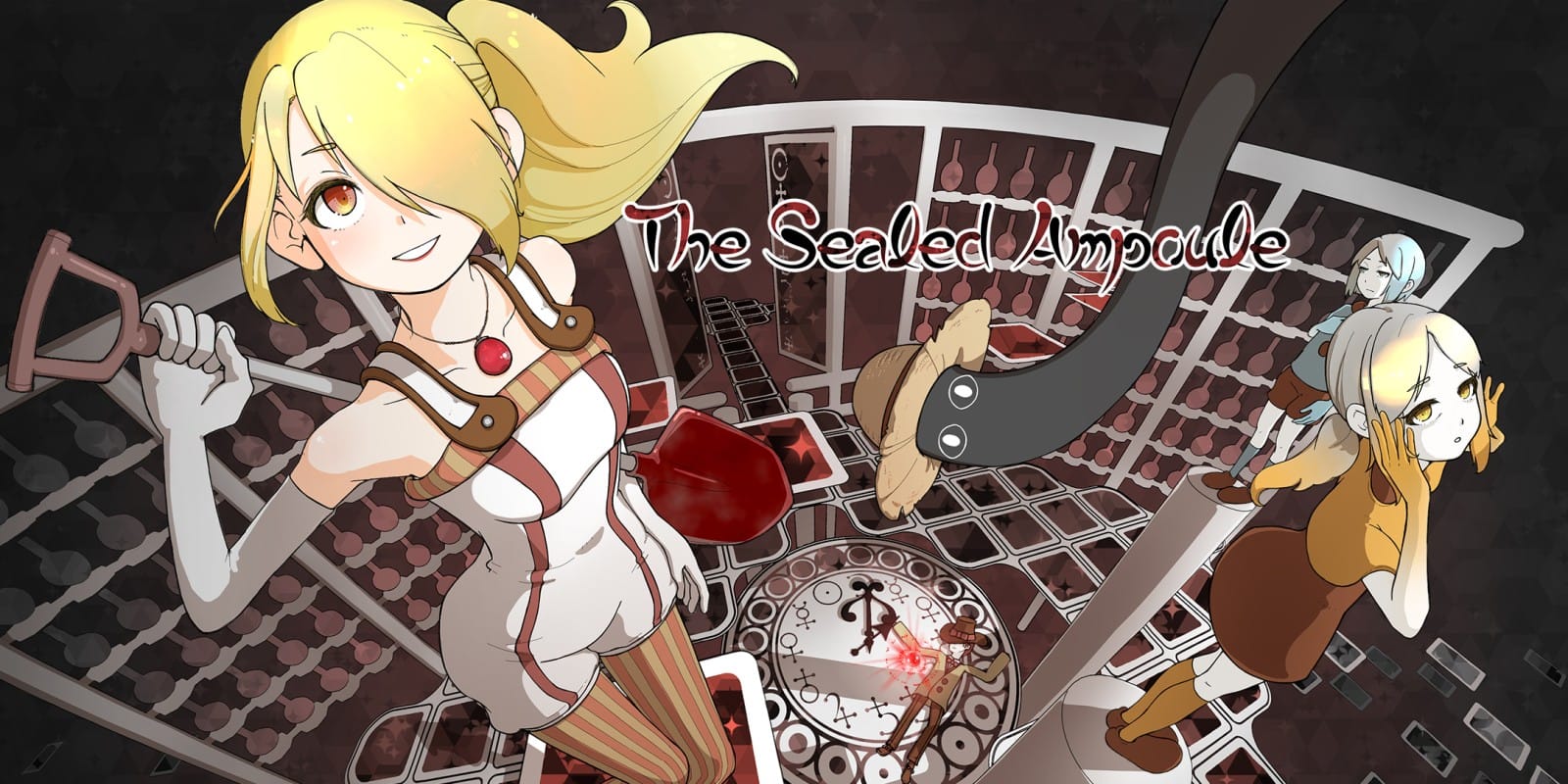
CAVYHOUSE's recurring character Irene the alchemist (who is the protagonist of their hybrid clicker-farming sim-dungeon crawler The Sealed Ampoule), is a deconstruction of the magic shop owner archetype. While she shares the charm, cunning, and karmic business sense of other proprietors of the tradition, Irene is a lot more self-serving and chaotic in how she relates to both customers and business partners. The mechanics of Forget-Me-Not and the positioning of the player as Organa, who's arguably a deuteragonist to Irene, figure into the patterns of this type of story as well.
In addition to the proprietor archetype, assistants or apprentices are often present in a magical shop narrative. The shop's assistants can be trickster-like accomplices, like Belus the demon in Tarot Café or naïve like the customer-turned-assistant Aaron the werewolf. In the case of a protagonist like Watanuki, he is pressed into service indefinitely to Yuko, as she senses his deepest wish to no longer see ghosts and binds him to a contract. At first Watanuki is more of a bewildered go-between for the customers who are drawn into the storefront. Only later does his attachment grow strong enough to Yuko and her plight in "helping" customers learn their perilous life lessons that he decides to become more akin to an apprentice in his role. Organa is more formally apprenticed to Irene yet so eager to serve that she seems enchanted or otherwise made to be obeisant to her Master. The true ending reveals why Organa is so willing to slave away in the greenhouse and even risk her life to protect Irene—she's essentially a homunculus of Irene's cat, who passed away at the start of the game. When dead humans and animals are given an organ fruit to grant new life, they no longer possess the same identity.
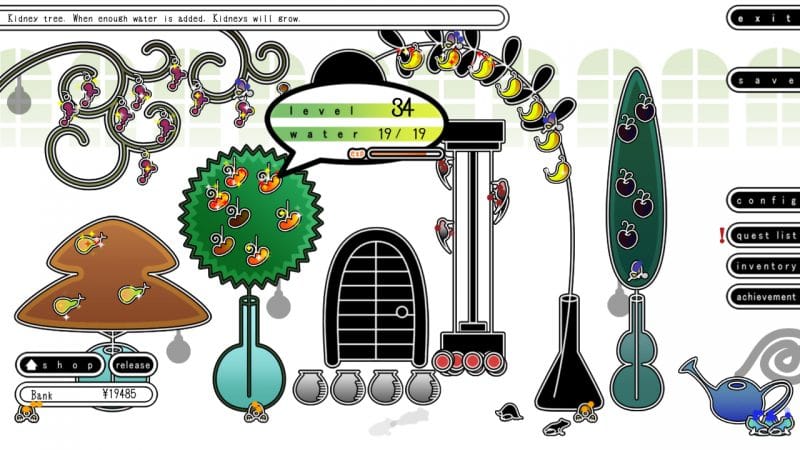
Irene seems benign at the start of the game, selling alchemical organs that can enhance customers lives or grant new life to the dead or inanimate objects they bring to her. Organa, as Irene's apprentice, appears even more innocent. But the player is always somewhat aware of how their clicking keeps an extractive and exploitative system churning out ever more products. As Neima Jahromi notes in their New Yorker piece about the philosophical underpinning of clicker games, the player is positioned in such games as "a middle manager of [eventually] automated clicking" and such optimized clicking is comparative with "real work". Or if not real work, the mechanics and system are at least akin to David Graeber's concept of "bullshit jobs" in that there are many pointless metrics involved and the job itself could easily be rendered obsolete if fully automated. Furthermore, the arbitrary nature of shadow pricing is commented on via the narrative arcs of the customers who visit Forget-Me-Not's magic shop of soul-bearing organ fruits. Additionally, this magic shop framework comments, albeit somewhat obliquely, on late stage capitalism's ecological crisis of infinite growth mindsets and extraction of finite resources. I think here of how certain goals for the player reference cultivating monocrops on a global scale, optimizing tools to facilitate mass fertilization and harvesting, and Irene's partnership with the Pololokka company, which denudes the surrounding lands of the village of animals.
Throughout the game the tools you upgrade, like the watering can (which eventually is labeled for ridiculous capacities like "canal" and "reservoir") , and the creatures you purchase from Pololokka's Catalog take on increasingly sinister implications for the ecological impact alchemical gardening has on the local community in the game. My purchases of mundane animals from Pololokka like lizards, hummingbirds, and moles triggered The Quiet Villager's quest line. The Quiet Villager, a farmer, reports that the land has become barren. Irene feigns ignorance and ropes The Quiet Villager into further deals for things like organ fruit mincemeat, in the hopes to return animals to the arid soil and trees and rid the lands of bug infestations. Irene's business sense is as ruthless as it is deceptive. As much as the game's nemesis Chika is manipulative and destructive (to both bodies and property), you can understand how Chika sees Irene's alchemy as twisted and insidious as well.
As a related stylistic aside, what makes Forget-Me-Not a compelling clicker game is a mix of its kimokawaii (or creepy/gross-cute) tone and its choice of sub-genre. Forget-Me-Not is an unfolding idle game, like the classics Cookie Clicker, Cow Clicker, and Universal Paperclips. Unfolding games reveal new mechanics incrementally as you progress through them, adding new dynamics to accelerate and eventually automate your progression. The unfolding element also adds to the ecological subtext of the game, revealing a slow and then accelerating extractive violence done to the environment and its inhabitants. In other words, as the player optimizes their clicking system, they by extension are expanding Irene's business empire. Combined with the aforementioned kimokawaii tone, achieved through visceral throbbing sfx juxtaposed with a haunting lullaby-esque soundtrack and storybook-like concept art, the game underlines the absurdity of commodifying life and lived experiences. Irene will often make off-hand comments that even the most engaged player can be thrown by as well, such as likening the organ fruits' warmth to the temperature of human flesh. In other words, you never forget that what you're selling to customers are organs. Because they are alchemical fruits of life, you are shadow pricing life itself. And there's no real way to ensure that customers will be purchasing a meaningful life or, by extension, life experience. As with most stories told in this magic shop genre, a life well-lived is something that cannot truly be afforded by even the extraordinary goods and services proprietors have on offer. A meaningful life is not monolithic and is often unique to every individual, relationship, or community.
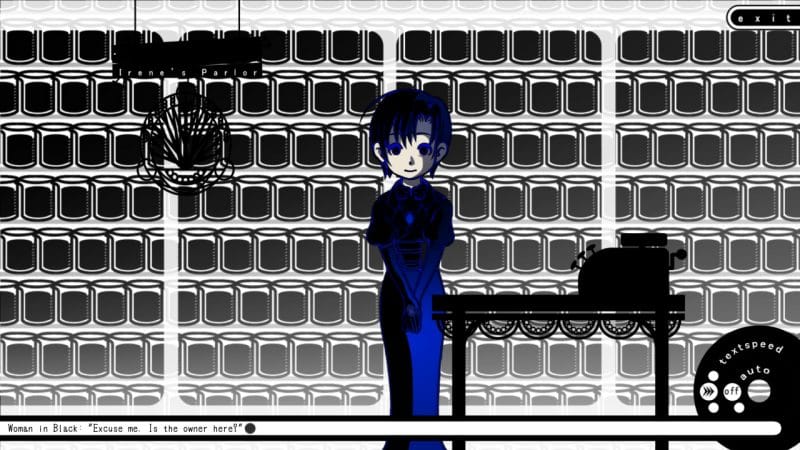
Key to all magic shop narratives is customers getting what they deserve, not what they want. The shop owners almost always characterize their establishment as granting wishes or helping customers achieve their dreams. But the transactions often cost dearly. In the first volume of XXXholic, owner Yuko explains the way wishes are granted when Watanuki asks why he was inexorably drawn to her shop. Magic shops are often in extraterritorial areas in these narratives, like Count D's pet shop selling supernatural beings in Los Angeles's Chinatown, or can only be accessed under specific circumstances, like Pamela's seeing more-than-human customers after midnight at her cafe. In the case of Yuko's shop, the building is invisible to those who don't have a deep-seated wish. Yuko's explanation of a fair transaction reveals the moral ambiguity of magic shop owners and their sense of responsibility, qualities Irene both displays and pushes against. She details how "Proper compensation must be made for offered goods and services. One must not offer too much for the payment. One must not charge too much for the product." If a transaction isn't "equitable", then "Someone gets hurt" in the bargain.
What can be injured by a magic shop transaction? In XXXholic's case it can mean bodily or spiritual harm. One can even lose their soul. In TheTarot Café the terms are similar, but customers have the added boon of Pamela's gift of foresight, to follow or ignore at their peril. Count D's pet shop gives explicit instructions on how to care for and placate the fierce supernatural beings sold, but reserves a shady clause, absolving the shop of consequences if the customer decides not to follow said instructions. Count D is also more of a trickster in this last regard, as for all his cautioning, he never mentions why it's imperative customers follow his care instructions as part of a signed contract. Forget-Me-Not's Irene presents herself simply as a producer of magic items, no more and no less. She does offer advice to customers to ensure their safety (and by extension, her lack of liability) but often, like Count D, conveniently keeps consequences of ignoring her advice vague. For the most dangerous of these scenarios, in counselling customers not to place multiple organ fruits to take root in one body or vessel, Irene merely states something "terrible" will happen. Unlike her fellow magic shop owners, Irene does not see her business as part of a larger design.
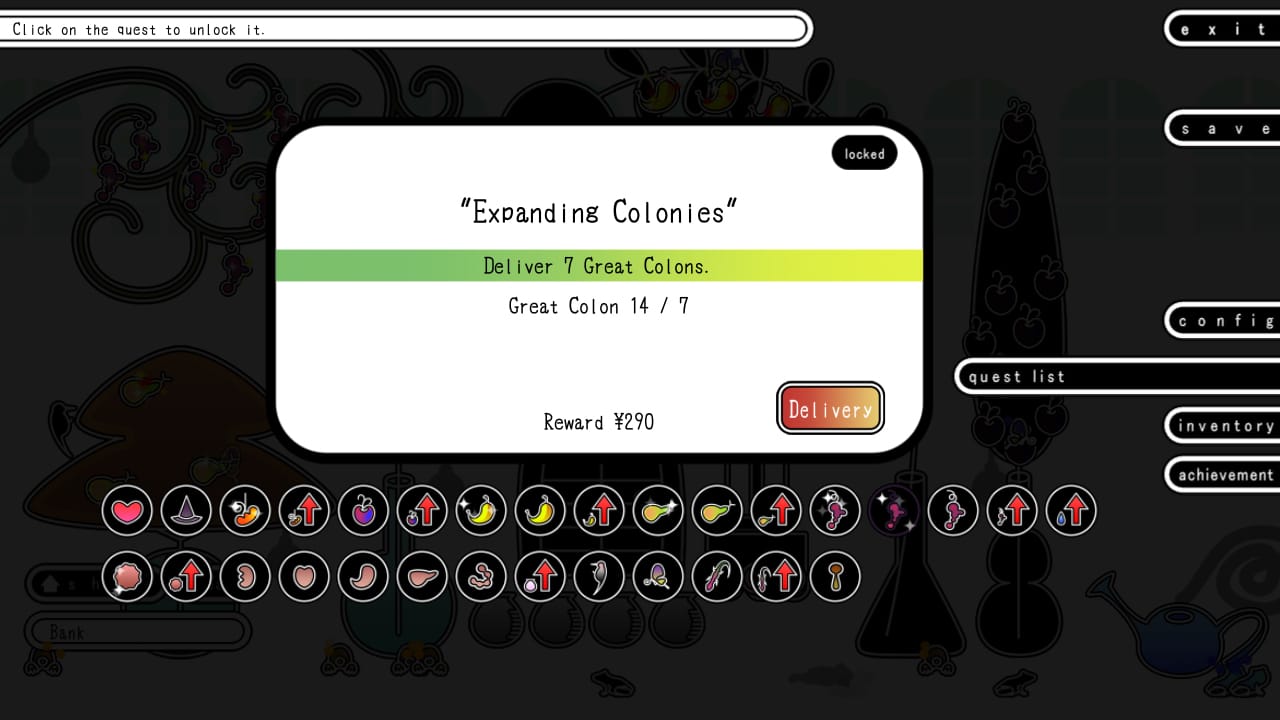
In the following game, The Sealed Ampoule, we learn two crucial details of Irene's character, which are echoed but not fully examined in Forget-Me-Not. First of which is how for her, alchemy and business are one and the same. She states in the introductory scene of the game that producing quality alchemical items to sell "is like Alchemy 101". Secondly, Irene's shop is a coping mechanism for the grief of losing her mother Marie. The Sealed Ampoule's opening sequence implies that Irene became an alchemist shortly before her Marie passed away and explicitly states that she wanted to open a shop "in order to help get over the sadness of having lost her mother." While Yuko keeps the balance of the multiverse as the Space-Time Witch and Count D--at least in the 90s anime miniseries– is the caretaker of exceedingly rare, endangered (and often deadly) animals, Irene's alchemical business venture is a means to distract her from mourning her mother and cat. The closest she compares to other magic shop owners I've mentioned above is Pamela, who initially seeks to break her curse of immortality and peacefully pass into her final rest. Pamela's lesson, like Irene's, is concerned with how to live a full life without regrets. The difference between them, however, is that it's nebulous whether Irene's shop and her apprentice Organa are helping or hindering her grieving process. In a sense, Irene's positioning in this unfolding clicker game is similar to characters in games I've previously discussed in TIER's Welcome to Elk issue, who process their grief by making meaning out of objects they have close at hand. But unlike those characters Irene is isolated in her grief, and she is wholly aware that even with access to miraculous objects like the organs sells, she cannot resurrect those she's lost.
The magic shop narrative is a great framework for a clicker game for a number of reasons.There's a drive for constant progress or growth, an easy way to organize the levels and their attendant difficulty according to the individual plights of the customers. Most importantly, the genre is transactional. The transactionality is given extra weight due to dealing with organ fruits that can enhance human bodies and animate dead or inanimate bodies and objects. Similarly to Universal Paperclips, Forget-Me-Not's concerned with the question of value. How meaningless are the products or services you cultivate in satirical clicker games, in comparison to irreplaceable things like a livable environment? The customers of Irene's shop fall into two major categories of value: tangible goods that can continue the chain of capitalist exchanges and those seeking an experience they believe only the fruit can facilitate for them.
Regarding the first category, the most exemplary customers like the clumsy Witch who creates Homonculi that are eventually available to purchase via the Pololokka catalog and the Merchant from said catalog's firm who seeks to create an extraordinary luxury item for their clientele. Both the Witch and the Merchant don't care for the vitality that the organ fruits offer, their end goal is to profit from the goods made from those fruits and their alchemical qualities. Especially in the case of the Merchant, whose team of researchers develop first a "Matteradio" which enables gardeners to hear what plants are saying on a rare frequency and eventually a device called a "Matteringual" that enables gardeners to converse with their plants. The value of these goods, despite providing the producers with cash flow, is rather arbitrary. Both take an extraordinary amount of time and resources in game to make. The ability to hear and converse with plants, as Irene notes, is useless for those professionals who know from hands-on experience what individual plants may need.
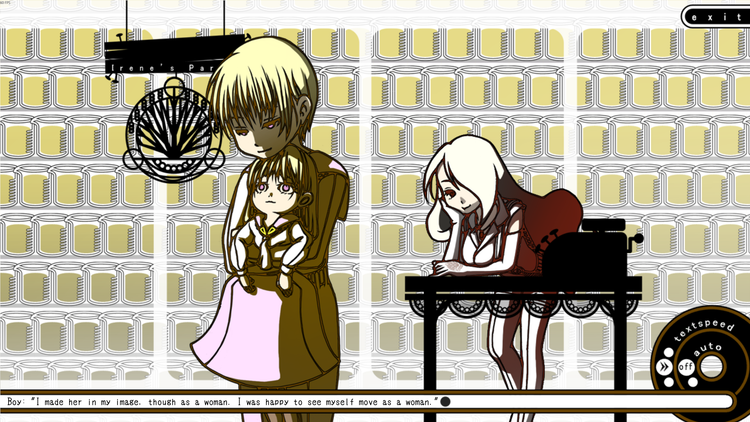
Conversely, customers who want organs in order to have a personal moment of fulfillment or to improve a relationship often gain value in the form of life experience. Such is the case with the sickly boy who wants to become physically stronger in order to be more sporty with his friends. His friends at first are happy that he can keep up with their pace, but as the boy continues to get more surgical implants of pickled organs, he is accused of "cheating" at games. Or the boy who wants to animate his feminine doll created in his image so that he can see what he'd move like as a girl. The doctor of the town treats his frequent purchases as a way to show his worth as a life partner for Irene, which imbues the organs with a similar kind of value to a dowry or bride price.
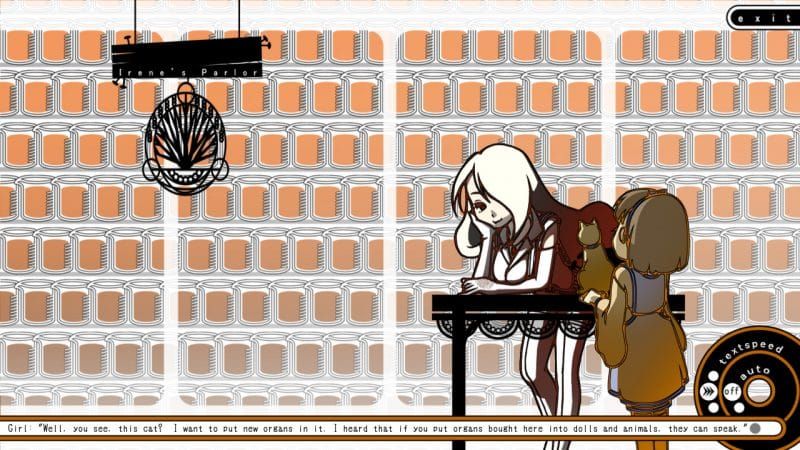
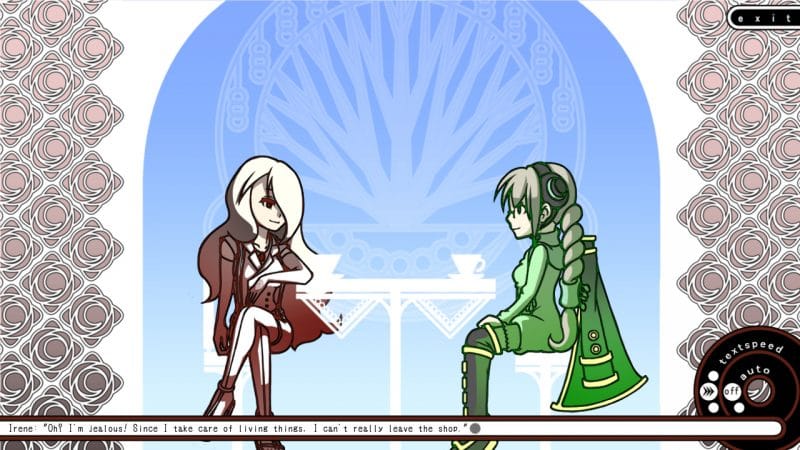
One of the most harrowing customer scenes in the game, in my opinion, is one that offers a brutal mirrored image to Irene's reviving of her family cat. A girl wants to talk with her pet cat and despite Irene's counselling that the cat would have to die in order to be revived with an organ that could make it talk, the girl kills her cat and then returns to order Irene to sell her the organ needed to achieve her goal. Irene acquiesces but is clearly disconcerted by the girl's cruelty. Perhaps she is even wondering how different her treatment of Organa was. Throughout the game, Irene takes the credit for Organa's hard work producing the items for customers' orders and she often leaves the shop for tea time with an old friend Hamomoru while Organa labors on. Although this quest line ends on a better note, the girl having realized that she's bonded with the new cat after many fights about it not being as well-behaved as she'd like, most of the arc is about how capricious and controlling the girl is towards the cat's life. Her affection for the cat is selfish and although Irene isn't nearly as cruel, her resurrection and remaking of her own cat's life is also self-centred.
This last point of grief, love, and selfishness as drivers for alchemical creation of life (or the life one wants to lead) is what kept me hooked on the punishing grind of raising more and more fruits via hours of clicking. The game's tone is thoroughly bittersweet and surreal, akin to Ikuhara Kunihiko's Mawaru Penguindrum, but has a lot more focus than Ikuhara's eclectic storytelling style. Forget-Me-Not's subtle critiques of how much an individual is willing to exploit their environment in order to achieve emotional satisfaction or experience a fleeting moment also recalls for me some of the themes of exploiting vulnerable others to avoid inevitable entropy in Urobuchi Gen's Puella Magi Madoka Magica. In both narratives, figures like Organa and Madoka have a gift that keeps a corrupt system running and enough naïvete that their master can manipulate them into a sense of obligation toward that system. Though Madoka becomes wise to Kyubey's manipulation, Organa is more or less Irene's puppet and as a sentient cat her logic is much more limited. A lot of this feels outsized for a satirical clicker game, but philosophical questions and scenarios are often explored at some length in even the most silly of this genre's concepts. Cow Clicker's goal, after all, was to critique the burgeoning attention economy in the 2010s and the monetization of social behaviors in games.
As associate professor and game designer Jessica Hammer defines it, as Organa your role exemplifies the dynamic of "playing at planning" , or deriving pleasure from the anticipation and planning of cultivating your garden. Hammer suggests, in conversation with People Make Games, that this sort of ludic pleasure is akin to vacation planning. Both activities give you an anticipatory high which then encourages you to plan your upcoming actions and take time out of your real-time schedule to ensure you get the maximum amount of pleasure out of your results. This applies whether those results are going on a relatively stress-free vacation or reaching a high yield of excellent quality organs from your garden. In this way, the shadow pricing principle in Forget-Me-Not also includes the player's time and physical effort (which does add up to many hours and at least a few hand cramps). When Organa speaks via the Matteringual to the organ trees, she states during one talk that she sees these trees of life as her "special property". She says this in spite of the fact that she has come to know each of the trees as individual more-than-human beings. But the player has been primed to view the trees and the system of Irene's magic shop in this capitalist way because they've cultivated them as products.
Forget-Me-Not's ecological subtext and how its emphasized ludonarratively was in this way ahead of its time in 2015. We now are in the era of rivers being "granted legal personhood and rights", like Québec's Muteshekau-shipu (Magpie River) as of 2021. Upcoming games like Speculative Agency's All Will Rise, which will see players taking billionaires to court for the death of a river god, seem only a natural progression within this paradigm. But it's always worthwhile examining how long it took for more games to take a more explicit approach in this regard. For that reason, I accept the costs of Forget-Me-Not's shadow pricing of my time and effort. But it doesn't make the experience any less unsettling.