
The Punctum in LAKE Adventure and Mystery in the Digital Age
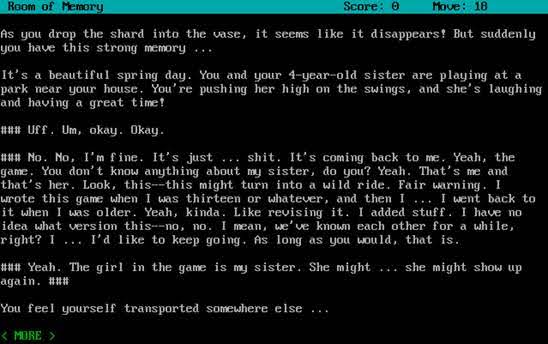
The interactive fiction game LAKE Adventure, by B.J. Best, is something that must be found and figured out, as well as played. In a digital medium often thought of as immaterial, it is a perfect example of an artifact that feels dense and layered, almost like something you can touch.
Released during IFComp 2023, LAKE Adventure is the first game entered in the Comp since 2003 to be made with the Adventure Game Toolkit (AGT), an authoring tool mostly popular in the 1990s. A player who downloaded it among IFComp entries in 2023 would have ended up with a folder full of files with unfamiliar extensions; an executable file that, if clicked, would likely throw an error; a PDF of a scanned notebook with the handwritten name Eddie Hughes and maps alongside scrawled phone numbers and doodles; plus a text README file explaining that the game requires a DOS emulator or one of a few specific IF interpreters to be played.
The game’s plot mirrors this dynamic, of running into and figuring out an initially mysterious digital object. In the game, set during the first few weeks of the COVID-19 lockdown, protagonist Ed Hughes is revisiting a (fictional) game he himself created at 13 years old, in 1993. The LAKE Adventure we play in 2023 includes this 1993 game, as well as lines spoken by Ed to his work colleague, who is implied to be running the game on his own computer and sharing it with Ed via videoconference. At first, Ed seems to treat the situation as a nostalgic indulgence, one of those things one did to pass the time in lockdown – the whole thing comes about because he finds his old disks when “cleaning out a closet because what else are you supposed to do these days”. He starts out saying it will be “fun to laugh at”, mocking the “realistic rendering” of his bedroom and giving his colleague context for details like the stencils that his mother decorated the upstairs hall with. Gradually, though, revisiting the home he grew up in and that particular time in his life brings back to the surface memories Ed didn’t prepare for: of his sister’s death from leukaemia, his dad’s leaving, his difficult relationship with a childhood friend.
The story in LAKE Adventure emerges in this combination of the deceptive simplicity of the game we play and Ed’s unveiling of the tragic events that inspired it – but also, it emerges in the myriad little things we experience that Ed’s commentary cannot contain. In traversing LAKE Adventure, the unfinished game by a teenage boy, we interact with an object created by a specific individual at specific moments. We see – and we examine, get, use, drop – marks made in those moments, captured on AGT game files on a floppy disk kept in a closet. Despite it being digital and textual, and, as such, doubly associated with immateriality, LAKE Adventure gets much of its affective punch from what can very well be called its texture, from its DOS look, awkward map and bits that seem pointless or missing.
In Camera Lucida, Roland Barthes famously discusses the studium and the punctum as two distinct ways one can be interested in a photograph: the studium is “a kind of general, enthusiastic commitment, of course, but without special acuity”, a conscious acknowledgement that, however, doesn’t puncture the viewer, doesn’t move them beyond interpretation. The “special acuity” comes with the punctum, which is always, in some way, a detail, that overflows what is legible and hits the viewer with huge force and without explanation. Barthes’ examples include the “belt worn low”, “arms crossed behind her like a schoolgirl” and “strapped pumps” of a woman in a photo.
We can think of LAKE Adventure as a work of the digital punctum thus defined. There is the studium of the fictional game we play, rudimentary and harmlessly “retro”, and then there is what unexpectedly erupts in details: in the “relatively long bench” that seems to have no use, in the word “vidiot”, in the sudden game over when one goes north from the porch, in the anchor earrings left in the middle of the lake, in the too many exclamations used to announce Eddie’s brilliant future.
These are details that concretely bind this game, a file from the 1990s, to the uniqueness of past moments. Barthes’ book is about photography, and though it – being published in 1980 – doesn’t directly address digital photography, what it articulates about analogue photography is often contrasted with the digital. In particular, what is called the indexicality of analogue photography: its causal, physical relationship (through the contact of light and film) to what it depicts, supposedly lost in digital photography. In Camera Lucida, the punctum derives from indexicality when Barthes is touched by the presence, the “that-has-been” of a photo, “the necessarily real thing which has been placed before the lens, without which there would be no photograph. Painting can feign reality without having seen it … in Photography I can never deny that the thing has been there”. Furthermore, a photo is considered a link, an “umbilical cord” to this real thing, because “from a real body, which was there, proceed radiations which ultimately touch me, who am here”.
In digital media, this link is complicated as the image doesn’t appear out of the chemical reaction of film exposed to light and developed, but out of the algorithmic reconstruction of the image as zeroes and ones. This is taken to sever physical continuity and, perhaps, to weaken the punctum, to limit the digital to studium. Barthes considers the “power of authentication” greater than the “power of representation”. The latter is proper to abstract forms, such as language and, some would argue, digital media, which can only construe things that may or may not have been; the former is proper to analogue photography. He tells how he once saw a picture of himself he couldn’t remember being taken, but that “because it was a photograph” made it so that he couldn’t deny that he “had been there” – it, and every photo, was “a certificate of presence”.
This opposition of analogue vs. digital in photography connects to broader ideas of the digital as disconnected from real lives and bodies and, therefore, muted. We recognise this when someone says that listening to vinyl “hits different” than digital formats, or that zines will always “feel more personal” than blogs, or that getting a letter is inherently “more meaningful” than getting an e-mail. LAKE Adventure is one counterexample to these ideas. It shows how the digital can, to use Barthes’ phrasing: “reach me, animate me, and I animate it … this is what creates every adventure.” The digital can reach, move, touch and be touched.
Barthes is disconcerted by the photo of himself as an undeniable imprint of his own presence, even when he can’t remember it. Ed is similarly disconcerted by the game he made as an undeniable imprint of himself at 13, even when he can’t or doesn’t want to remember it. Both are powerful, in mysterious ways. I am, of course, purposefully stretching Barthes’ arguments on the punctum and indexicality of photography, in order to try and speak of an experience with interactive fiction that is of a very different nature to what he explores in Camera Lucida. I am doing this because I do think the force he writes about is a needed sentiment in understanding what we do and feel with computers.
In his recent essay The Reenchanted World: On finding mystery in the digital age, author Karl Ove Knausgaard wrestles with his felt detachment from the digital technology that, nevertheless, now permeates his life. He starts the essay filling it up with details of the world he remembers from his analogue adolescence in the 1980s: the river that overflowed its banks every autumn and spring, the roaring of water, the thick air as he biked uphill – on his way to see the friend who showed him a computer for the very first time. At the end of this journey, described in terms of organic sensations, is the computer, “a gray metal box and a dark screen with bright green letters”, divorced from the life and nature around it. “Forty years on,” he writes, “the technology in the gray box is everywhere”, but he still can’t bring himself to care about it.
He spends the essay, as its subtitle indicates, searching for “mystery” in an age when, because everything has become encompassed by the logic of the computer, everything feels flat. What used to be the environment has been reduced to information on a screen. What was indexical, traces of physical presence, has become symbolic representation, thin.
In Knausgaard’s accounts of this odd new digitised reality, technology arrives ready-made to passive consumers, who are deluded by its renderings. Technology is the stuff he sees on his phone, or the synthesised voices he hears in train stations.
I suspect he might have found something different, had he ventured down an itch.io or IFDB rabbit hole.
I don’t know why I love interactive fiction. Like Barthes and Knausgaard did, I am writing this in an exploration of something intense that I feel, but can’t quite explain. I know that I do, that I love it, that it is something I feel on the level of emotion. For Barthes, the studium is “of the order of liking”, but the punctum is of loving. I feel that these games, whatever they are – whether I find them to be “good” or “bad” or “fun” or “not fun” – are dense and delightful artifacts. This isn’t to say there aren’t many IF games that also exceed any metric of complexity and polish that might be applied to them. But, for me, there is inherent pleasure in the acts themselves of finding these things and running them, clicking on all their links, browsing all their files and seeing what they are. They are sometimes wonky, maybe with typos and implementation errors, maybe with run-on sentences and twisty plots, and they are often incredibly innovative. As objects I interact with through my screen, mouse and keyboard, they pulsate with life.
I suspect there are others who feel the same. In recurring discussions in the IF community on what place AI should have within it, many anti-AI arguments draw an indispensable relationship between IF and a human creator. Intrinsically human things like effort and reflection – and the traces left by those, also in the code, grammar etc. of a game – are defended as being at the core of IF.
Our computers don’t have to be transparent portals into bland abstraction, though they can feel like that. Knausgaard first finds mystery in the digital age when he decides to replace the dead plants in his garden himself, rather than let his gardener do it. Before, he’d let plants dry out because he had built no relationship with them. After planting his first flowers, though, he finds that he starts truly noticing his garden, in all its variations and its depth. In the next paragraph, he references Gilbert Simondon, who introduces him to the idea that technology is not necessarily alienating, what we need is to change our relationship to it, understand it and respect it more. But in the thousands of words that follow, that describe things from brain surgery to ancient rituals, not one of those descriptions is of a computer.
Or rather, one is: of seeing Babbage’s Difference Engine No. 2 at the Science Museum, and being flummoxed at its Industrial Age volume, all to produce a printed series of numbers. The way this passage is written builds to a clear letdown, the imposing machinery yielding something of no substance at all. Again, the duality: what moves us is the concrete; abstraction is always seen to weaken experience.
Finally, Knausgaard goes to visit James Bridle in Greece, having seen promise in their ideas of organic computers made of crabs and water. There, one of the things they tell him is that one way to make our relationship to technology less harmful would be to get more people involved in making it, so they could understand how it works and see that it is not that complicated, and that they can get it to do all sorts of stuff, maybe different stuff to what it has been made to do so far. This is the aim of the half-day programming seminars Bridle teaches, not for people to become advanced, well-paid developers, but simply for them to “see the edges” of what computing is.
I’m not quite as taken by fantasies of computers made of crabs. There has been plenty to impress me in the symbolic world of software, to the extent that it’s made by people finding the edges of what it is and can be. Exactly like Knausgaard’s garden, that comes to life after he starts tending to it, engaging with the handmade digital can turn the words and images on our screens from generic content into things we have inhabited and shaped ourselves.
B.J. Best has said he used AGT to make LAKE Adventure “for personal and narrative reasons”. He talks about the historical importance of AGT as “the first IF-creation system for non-programmers that achieved widespread use in the U.S”, preceding the rise of Inform. Though he points out its limitations, like the fact that NPCs can basically only be killed, LAKE Adventure shows those limitations being bent to accommodate a deeply personal story, for example when Eddie’s memories are coded as enemies and we get to choose whether or not to zap them. Best also cites Jimmy Maher’s consideration of AGT. In both accounts, it appears as representative of a perceived amateurism in IF. This is a history that starts with Will Crowther’s spare time project ADVENT, expanded by Don Woods and widely iterated on, through the so-called commercial era of Infocom predominance, up to the present day. As for Best’s personal reasons for using AGT, he explains: the opening acts of LAKE Adventure are the “ruins” of his very own first game, with much of the original writing kept. Ed and Eddie are fictional, but a lot of what we are reading are, indeed, the enduring marks left on a computer program by a thirteen-year-old boy.
In contrast with how AI has been met by the community, debates over the inclusion of games that extrapolate the strict definition of IF as parser-based text games have generally – if not at all easily or unanimously – concluded in favour of greater diversity. The 2025 IFDB Awards include categories for best games made in amateur tools from Godot to Ren’Py to Bitsy, among others. And though I won’t attempt to reduce IF to a definition based on this, it is noteworthy that the term can stretch to encompass wide variations in types of interactivity, levels of agency, centrality of the written word – as long as they remain expressions of dedicated authors – but clashes against the delegation of the making process to opaque generative systems. It strengthens the argument that amateurism is a vital aspect of IF.
It’s an aspect that makes IF a field of abundant opportunities for encountering the digital punctum. By “amateurism”, I don’t just mean an absence of commercialisation. I mean a scale and a mode of creation, where a game is crafted in the small, reflexive dialogue between one individual (or maybe a tiny team of friends) and their personal computer, via tools that are, themselves, human sized. In Graham Nelson’s words, “something is made as well as written”. There is a tangibility to it, for creator and player. As a result, as merrit k writes in her introduction to the Twine anthology Videogames for Humans, in these games one can feel “the presence of their authors … as individual human beings”; or, as Jimmy Maher writes in his post about AGT, worth quoting at length:
“To a much greater degree than the games of Infocom and other commercial publishers, AGT games feel like personal expressions of their creators. In later years, jokes and no small amount of scoffing would be attached to Everyone’s First Game, which inevitably begins in said everyperson’s bedroom and proceeds to play out in an environment interesting and meaningful to absolutely no one beyond the author’s friends and family. Yet the same tendency that spawns that phenomenon constitutes I think an important part of the text adventure’s ongoing fascination. … When we look back today to the AGT games of decades ago, they take on an additional layer of interest as historical documents in their own right of the times and places that spawned them.”
In the rolling stacks of digital archives, the world will not get thinner as Knausgaard fears. It will get almost unmanageably crowded, with the macro & micro of what people have lived through with computers. In there, you will not find mere images of the world. You will find the world. Decades-old grief, Sunday afternoon tinkerings, sounds of old software, exhilarating shows of genius, forgotten commands, thousands of messages in thousands of bottles. All carry encoded fingerprints, waiting to show us that they were there – until we, here, download and run them again.