
“The world is sick and ugly”
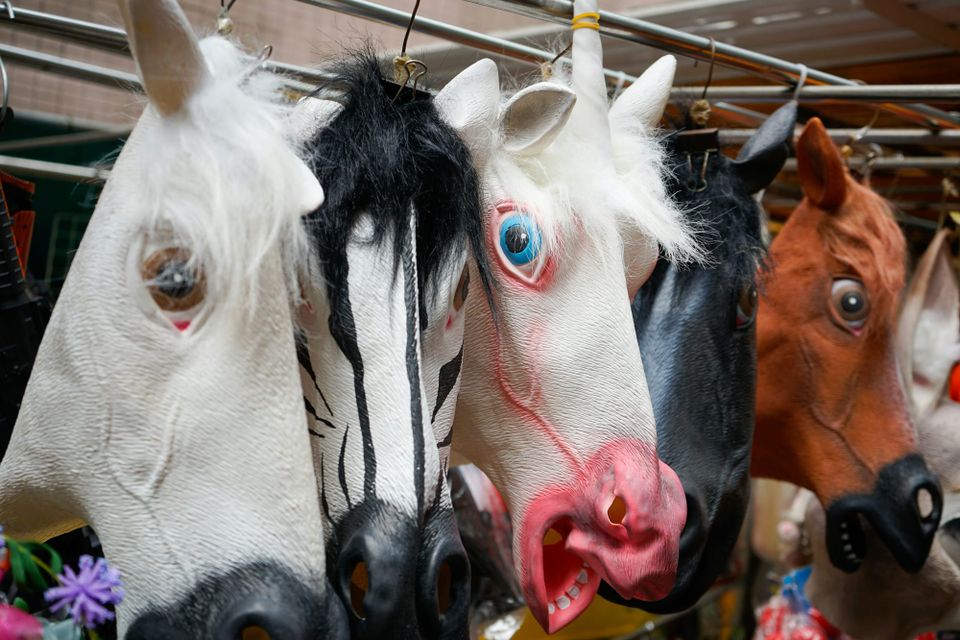
The limitations of Interactive Fiction provide a unique avenue for horror.
Text based games cannot replicate the kind of tension that many survival horror games thrive in. The possibilities for emergent gameplay from the ability to control a character in a tactile way, while balancing the risk of item management, is a key part of what makes survival horror work. The two sides are interwoven as your access to resources is often tied to how well you control the character. The control method of IF has a degree of separation between the player and the character in the narrator. This can turn the tension of horror into frustration if there's only one ‘right’ decision to move the story forward. Additionally, If there are unforseen consequences to the player's decisions, it can come across as a failing of the narrator and not the player. Creating horror in IF that makes the player feel responsible for their decisions is an incredibly difficult balancing act for the genre.
Horse Master, by Tom McHenry uses the limitations of IF to plant seeds of distrust in the player and creates horror by forcing them to make unclear or even nonsensical decisions without clear consequences.
Horse Master lulls the player into a false sense of security with its opening image of a cowboy riding a horse in the desert. It reinforces Western genre trappings, describing the protagonist as “Sturdy, calloused, windblown.” The game deflects from the question of what a Horse Master is by describing it jokingly as “A master of horses”. The game confuses the player even more as it forgoes the Western entirely for a contemporary-adjacent industrial Sci-Fi aesthetic. You are forced to pick between three different horse breeds created in a factory that are described with bizarre details including but not limited to: “no taller than 16 hands”, “they can range in color from #f9f9f9 to… #646270” and “poor hoof formation due to impure bloodlines”. The game overloads you with details about everything, from the necessity of a dangerous drug called Dexobrimadine to the looming presence of the legacy of the protagonist’s father, but it never tells you what you need to do. The anti-tutorial of Horse Master does everything in its power to confuse the player, make them uncomfortable and unqualified to make decisions for the protagonist.
Horse Master is actually a pet-raising simulator, where you have options as trivial as “feed horse” and as dubious as “Electrostim Horse Apodemes” to raise the following stats: “Glamour”, “Uncanny”, “Pep”, “Realness” and “Discretion”. There is no indication of what activity relates to what stat nor how any of those stats influence the competition at the end. You can only learn through trial and error. Descriptions of certain activities, the horse itself, and the protagonist’s dwindling finances add to the discomfort. You can inject nutrients into “the main nerve bundle of your horse’s central nervous system”. There is no description of the horse’s reaction to this, but you are instead told that it’s “Best not to dwell on how much it costs.” The horse’s growth is described as more insectoid than mammalian, going from larva to pupa, gaining a carapace, then becoming a foal as if nothing strange happened.
You also realize that the protagonist’s mental health is spiralling downwards. They lie awake at night and use the Dexobrimadine for themselves to “try and get to sleep”. The drug was never for the horse. Despite using it, each night their mind is invaded by self-deprecating thoughts. The game tells you that, “You lie awake for hours, absolutely certain this was a mistake,” but you have to keep training the horse. After the initial shock of the first act, the loop sets in and the protagonist gains more confidence in their horse. The way the game uses the same text every time you perform an action desensitizes you to the grotesque prose.
There are still violent images evoked in the language but it’s tinged with optimism. “Thanks to the dexobrimadine, you are able to move so fast that you only dislocate your thumb stopping [The Horse’s] powerful hooves from caving in your skull.” The hooves are described as “powerful”, so the skull caving is treated as a small downside to a net positive. What was a “mistake” at the beginning becomes an assurance that “You won't need a winter coat when you're a Horse Master. You'll never be cold again.” The numbers keep going up and the fear starts to fade away. However, every night, the protagonist’s paranoia about losing the horse gets more vivid until the game implodes on itself. You are reminded that the horse is not a horse as we know it, as late in the game its mane is described as “long prehensile tentilla… a surprise byproduct from the Fourth Evolutionary Improvement on the Foundational Horse Formulae (FHF).” Even with this knowledge reinforcing the doubt in the player’s mind, you have no choice but to keep going as if it is normal. Until you get evicted from your home.
The fears that had faded away return as you can no longer see the horse’s stats and you have no idea if your decisions led to the eviction. You can’t train the horse in the same way because you have no money. Your options are now limited to “Scavenge” or “Shoplift” for food, “hose bath” and “continue operant conditioning”. As the deadline approaches and the horse is fully grown, the buzz of the drug and the competition wears off and it is described as “a madness given form that is mostly under your control.” The protagonist then asks the question “If it could speak, would [The horse] think of you as a friend?”, providing the player further dread that you have been mistreating the horse the whole time. While that fear builds, the game finally moves on to the competition.
It is possible to get arrested for shoplifting or have stats too low to qualify, leaving the protagonist and their horse to die homeless and penniless. However, if you do qualify, the purpose of the game finally reveals itself. The competition is explicitly fascistic in nature, as a state senator proudly proclaims that his political opposition "...‘Would have you believe our ways — the traditional ways, mind you — are barbaric. Well what is more barbaric: the nobility of the majestic horse or the tyranny of socialism?’” The player has seen the barbarism of horse mastery on both the horse and the protagonist firsthand and fallen victim to its promise of escaping poverty through hard work. Still, the hint of more barbarism to come makes you instinctively know that there’s something deeply wrong with the competition. However, the prompt to progress is tied to the phrase “the nobility of the majestic horse” doubling down that you have to buy into that worldview to rise above poverty. There are no more choices after this point and you are left to your fate.
Once your horse reaches the “dressage” phase of the competition, the game stops shying away from its violence, as your character is handed a knife and forced to ritualistically sacrifice his finger to prove that the horse won’t eat it. The irony of this attempt to ‘tame a beast’ is made all the more apparent when the game has rewarded you for creating the beast in the first place, turning the entire concept into a farce. Still, without question, the protagonist removes his finger and the horse knows not to eat it. The mask comes off fully by the final event, the “cotillion”. This phase is specifically and proudly eugenicist. To further the irony, the game tells you that “Biology and development have chosen the true winner long before tonight” and all your hard work might be meaningless if your horse doesn’t fit the judges' criteria of the right genetics. The protagonist has to kill the horse to remove its “nerve disc”, which is then judged purely on aesthetics. It’s a final kick in the teeth that tells you that the work you thought you were doing, the creature you nurtured, was a vanity project for a senator. Horse mastery isn’t the most important title in the world, there’s no joy or pride in it, but it does give you money. If you win the competition, the game ends on this sour note:
“You made it. You are a Horse Master.You never have to (and never can) work again.The world is sick and ugly, but at least you made it through okay. You did exactly what was expected of you. Good for you! The life your father always wanted. Now you might even ask what kind of life you would have wanted, but it is too late to ever want again.”
The strength of Horse Master’s horror lies in how easily you fall into its loop and how powerless you are to change anything, all while the game, like propaganda, assures you constantly that every strange description and depiction of cruelty is normal because it rewards you. From the beginning, the artificiality of the horses and the reference to “impure bloodlines” scream that the whole system is immoral. Yet, the pressure to succeed from an invisible, unreachable father forcing his dream onto the protagonist makes it the only way forward. Every action and every decision you make is final and designed to feel wrong. The grotesque imagery alongside the declining health and morality of the protagonist are designed to make you fear failure.
The final line then contextualizes the whole game, clarifying why the game refers to the protagonist as “you” in the first place. The protagonist is trapped in the same game as you are, in over their head and never given another choice. They are anything but sturdy, calloused, and windblown, forced into a lifestyle they don’t want but have to accept, attempting to create a life that exists for someone else’s aesthetic pleasure. Their experience of poverty and addiction means that they can’t assimilate into a life of luxury. The reason "a Horse Master" cannot be defined is that, like the stats you so diligently built up, it is a name without any real meaning. The fear of failure turns to cynicism when you succeed. You’ve experienced the pressure and discomfort of how “sick and ugly” the world is and no choice on a list or bigger number can change it.