

Liyla and the Shadows of War in 2026
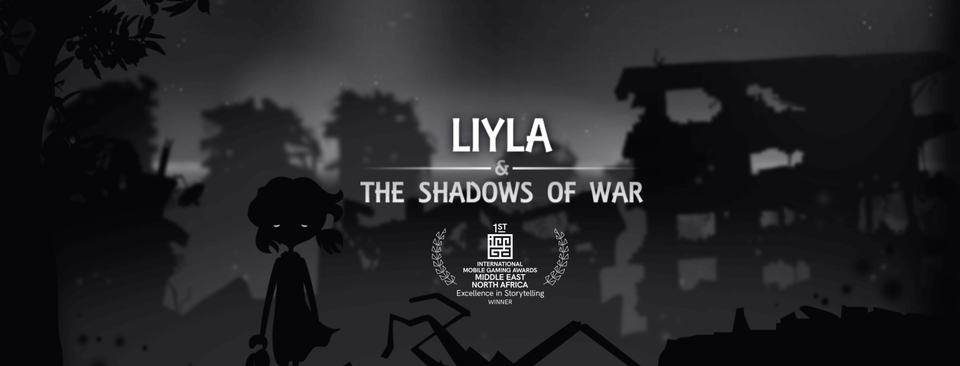
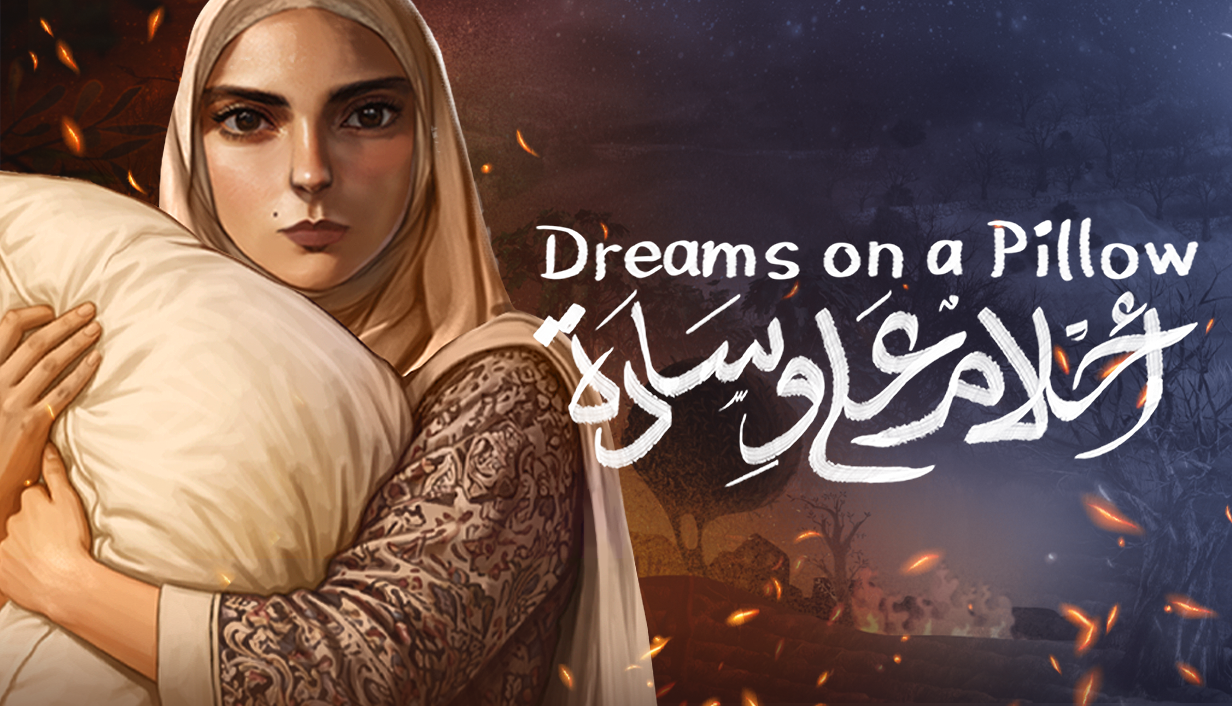
Liyla and the Shadows of War is a simple, short platforming game with choose-your-own-adventure elements where it is easy to die. The game, designed and directed by Rasheed Abueidah with art and illustrations by Wedad Irshaid and animation by Sarah Shawwa, was released in 2016 and recreates the violence of the 2014 Israeli incursion in Palestine (the “2014 Gaza War”). That is to say it precedes the violence Palestinians were met with at the 2018 Great March of Return, the 2021 crisis that emerged from the Sheikh Jarrah evictions, and the ongoing genocide that escalated in October 2023. It is also, though, decades after the Nakba, the First Intifada, and a decade-and-a-half after the Second Intifada. Liyla and the Shadows of War reflects an ongoing reality where Palestinians have their lands and lives stolen, their resistance to ethnic cleansing condemned despite international law allegedly enshrining their right to it. Palestinians, Lebanese, Syrians, Iranians, Egyptians, Jordanians, have all been killed to help Israel continue the spread of its undeclared borders.
Israel's settler-colonial aspirations were once tied more closely to British imperial interests during World War I and French imperial interests in the mid-20th century after the emergence of Zionism in Britain in the nineteenth century, though now the locus of Western power is centered in Washington, D.C., U.S., a state with which the Israel has a famously close diplomatic and military relationship.[1]
Nonetheless, some of these murdered humans (including peace protesters and reporters) had American passports, which should hypothetically save them from being killed by American allies, or indicate some consequence; some were doctors, some were scientists and academics, and many were journalists, in case particular jobs are needed to give human life value in your mind or heart; there were no shortage of aid volunteers; startling numbers of children, women, and the elderly, in case Arab men’s lives don’t mean enough to you. As Mohammed el-Kurd argued in Perfect Victims, the problem is not the gender or the interior thoughts of Palestinians, it is Zionist colonialism and violence. Not long ago, an American congressman had guns pulled on him by illegal settlers in the West Bank, blockaded by settlers and soldiers. There have been no formal consequences.
Palestinians have written fiction and nonfiction about the way their lives are treated as lesser and disposable. For material reasons far afield of morality, these people are made to pay for the crimes of Europeans and ambivalence of Americans during the Holocaust, as well as the preceding centuries of Christian antisemitism (despite the way Islamophobia is in the West to rationalize this extermination campaign, the bombs fall on Christian, Muslim, and atheists alike). Palestinians have made dramatic and documentary films, short and feature length, documenting their humanity and their subjugation to violence; they’ve written poems and memoirs and novels, histories and sociological and anthropological studies; painted pictures and drawn comics; they’ve designed and are designing video games.
Palestine is the contradiction which will dissolve the global order because it tears at our common illusions, the assertions and assumptions we have come to accept in our overlapping social contracts and consent to governance. All pretensions to our institutions caring about peace, freedom, or human rights die when the self-proclaimed leaders of the free world prevent scholars and prosecute children for condemning genocide. No amount of warnings or pleas seems sufficient to stem this tide of violence.
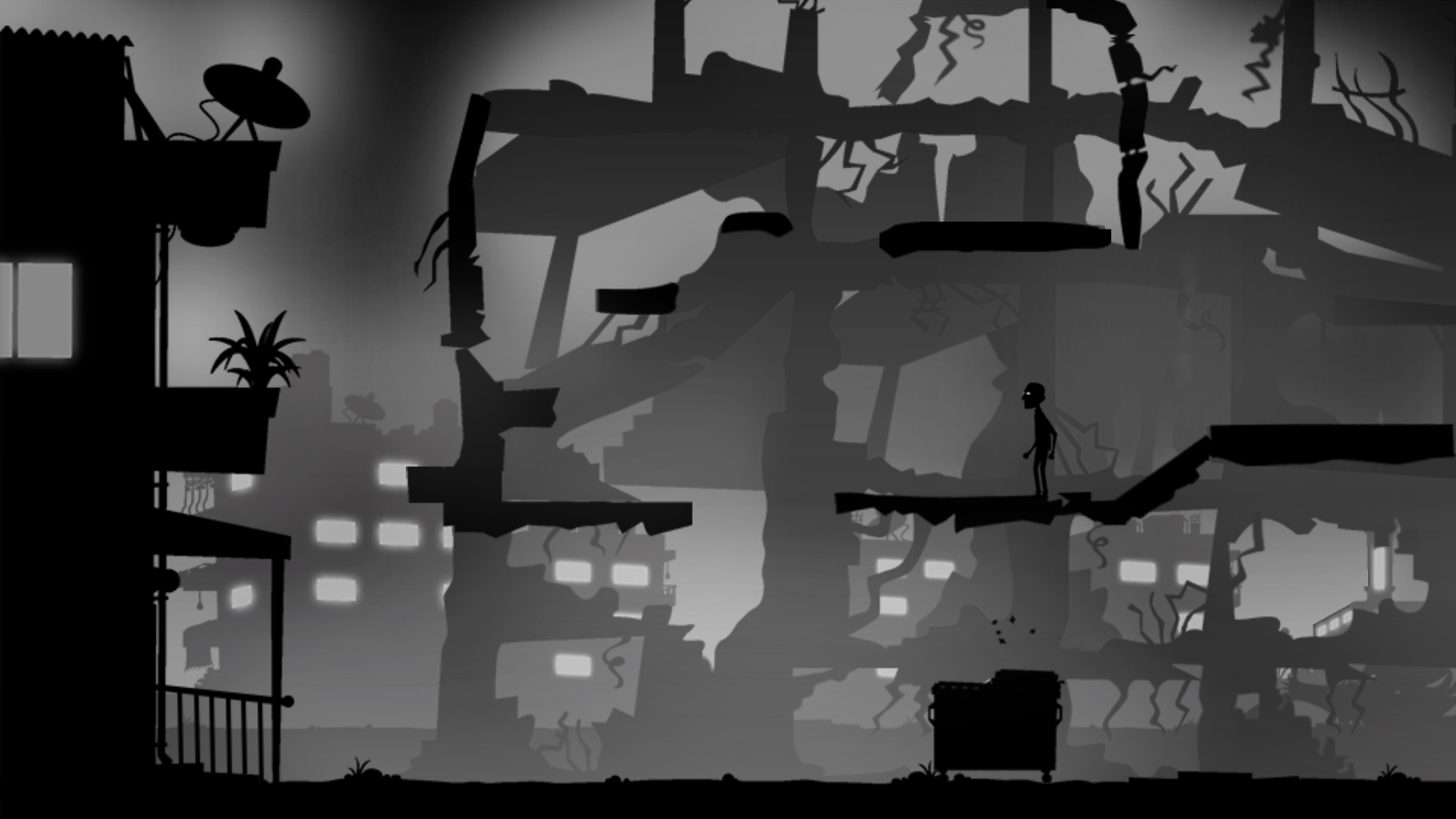
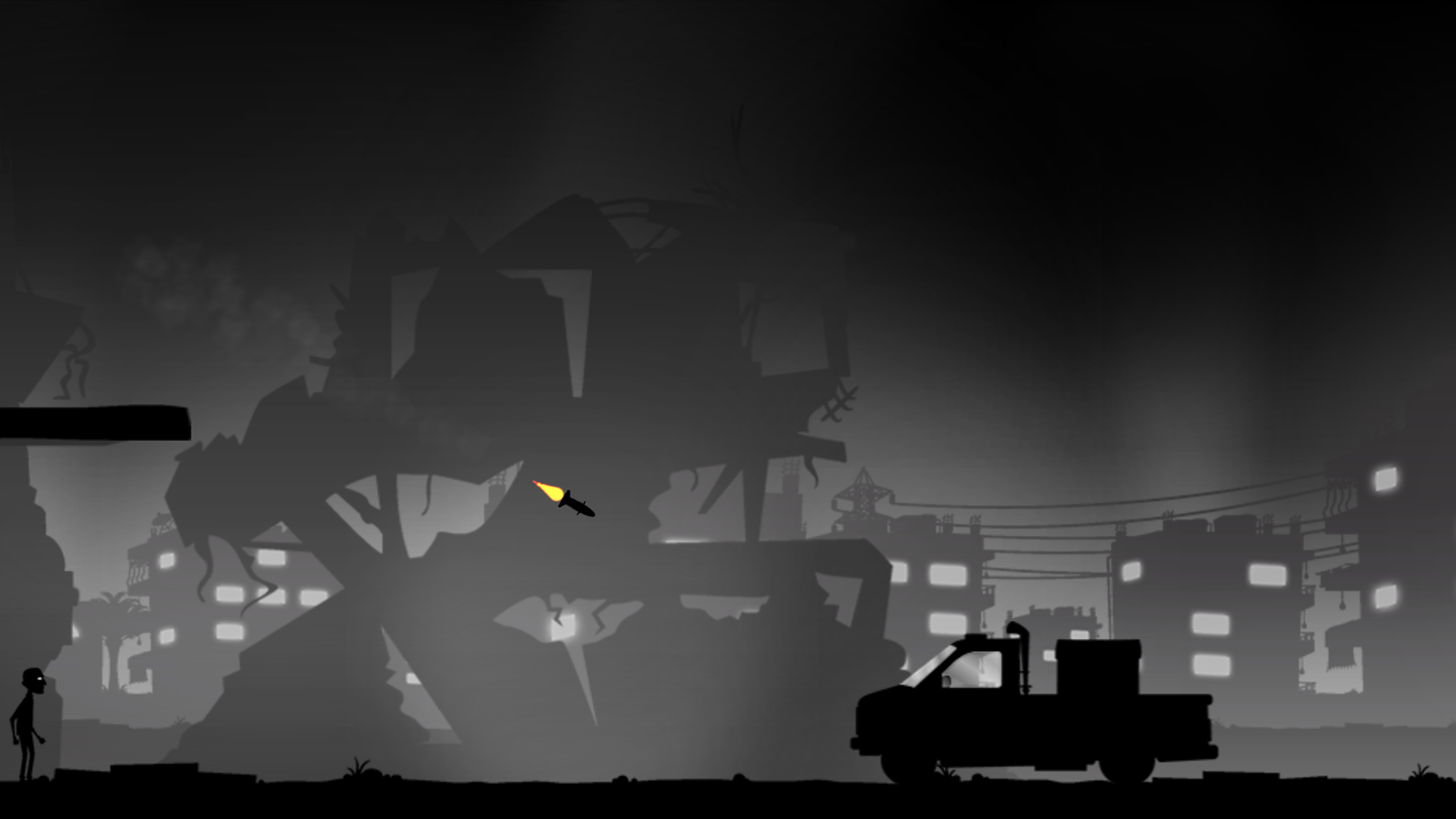
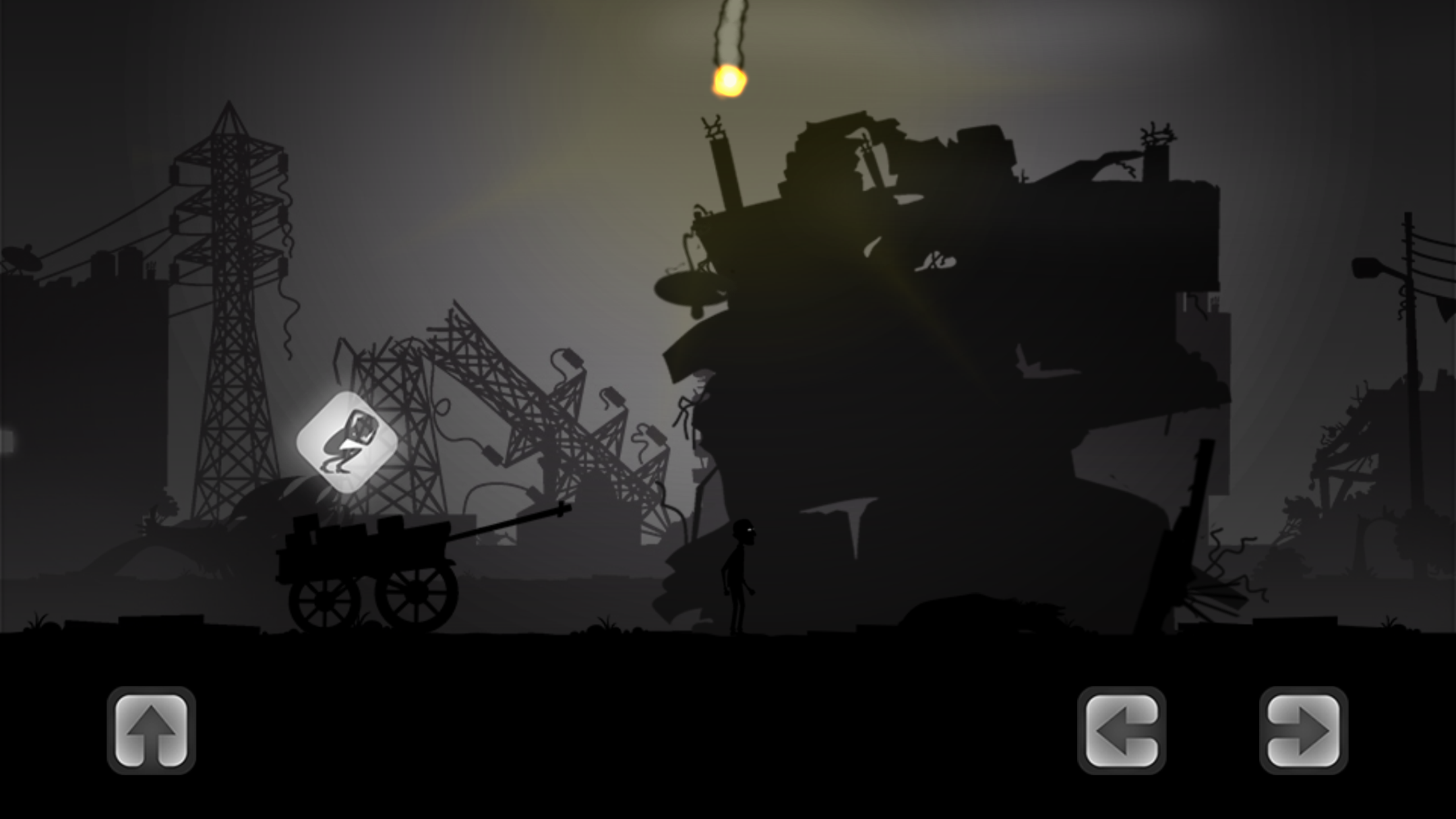
Liyla can be taken as such a plea, such a record. In Liyla and the Shadow of the War, you play as a stick figure father, trying to save his family during the 2014 bombing. After dodging drone strikes in the night following the destruction of a power plant, you find your wife and daughter, but your wife collapses from exhaustion just before white phosphorous rains down on you. Your daughter’s school is destroyed just after you happen upon it and consider it for shelter.
As Liyla’s father, you jump over exploding cars, dodge hails of gunfire, drone strikes, missiles, white phosphorous, all aimed as though they are intentionally finding civilians. You see no armed resistance in this game – no Hamas, no PLO or PLA, none of the Marxist-Leninist, Maoist, social democratic, nationalist, or Islamist groups fighting in coalition against Israeli aggression. You don’t see the insides of a church shaking or a mosque disintegrating, but you do see bombed-out buildings. You do see a school destroyed. You do see children playing with a soccer ball. If you try to save them, you die. If you don’t, they do (commemorating four boys killed on Gaza City beach playing soccer on July 16, 2014 – Ahmed, Ismail, Zakariya, and Mohammad Baker). Not long after, you find an ambulance, which only has room for Liyla. Just after Liyla is put in the ambulance, a missile strikes it.
It’s a harrowing and tense game of no more than ten minutes. It is violent, though – unlike in most popular games – you are only subject to violence, never capable of dishing it out. Your only aim is to survive. When you see your wife killed, you assure your daughter she is fine. You can’t look back. You have to keep going. But there’s no happy escape. Just death, loss, regret, guilt. Who makes such a world as this but humanity?
There is a beauty to the courage and resilience necessary to such an undertaking, the painful task of commemoration. It is never easy to talk about your suffering, even less so when the world’s powers want you to be quiet about it. At one point, Apple restricted the game from being released on its iPhone store, saying it should be classified as “news” or “reference” rather than as a game. After public outcry in solidarity, Liyla and the Shadows of War was put back on the App Store (where you can download and play it for free, like I did). The game was also part of a 2021 itch.io bundle for Palestinian aid that raised over $500,000.
Sometimes, as I see all the violence my tax dollars subject other human beings to, I wonder how anyone can believe in God. Perhaps one that is all-knowing, all-powerful, or all-caring could exist, but I can at best only give you two out of three. I think about the deep sadness my minor traumas have haunted me with in life and the faith in Allah or Jesus or reincarnation makes sense. The desire for an ordered universe makes sense. How else could you continue if you believed this bleak, uncaring world, where the most powerful defend the wanton murder of children, the razing of parks, the destruction of places of worship and schools and historic sites, the shooting of old women waving white flags, was all we had? Surely there must be a plan. Surely there must be something better.
The past two years and nine months have been a near-constant reminder that in this global “rules-based international order” that purports to prop up liberal internationalism but facilitates American dominance, some lives matter a lot more than others. Maybe not according to your own personal morality, but according to the calculus of the rule-setters and decision-makers. How many internationally renowned criminals get to address Congress? How many get free rein in New York City? The Constitutional promises of free speech and freedom of association appear not to apply to college students outraged at mass death if the mass death is orchestrated by the U.S. and its allies. These are the circumstances under which movements and organizations fighting for freedom and equality for all people must organize and operate. These circumstances are among the ongoing unresolved contradictions that are heightening in our time of global crisis.
This ten year old videogame highlights the recent history of this violence. Before Liyla's end credits, it gives you a run of numbers – 2,100 people died (according to the U.N., even more died than that); more than 1,500 civilians, including 538 children and over 200 women. 110,000 people were injured; 3,106 children, 1,970 women, 368 elderly. 1000 of the children will have a permanent disability. 22,000 homes were left uninhabitable; 108,000 people displaced. There were 28 schools destroyed. Electricity plants were destroyed; the game reminds us the use of white phosphorous constitutes war crimes; 8 hospitals and medical facilities attacked; 20 ambulances destroyed, 32 people killed at schools.
In the genocidal war since 2023, there have been at least 73,300 direct killings, 463 deaths from famine confirmed, and at least 10,000 people presumed buried under rubble. There are at least 173,900 people injured. By January of 2025, almost 1000 mosques had been destroyed, as well as nineteen cemeteries and three churches (the third oldest church in the world was destroyed with eighteen people inside it). By August 2025, about 641,000 people experienced catastrophic levels of food insecurity, according to the Integrated Food Security Phase Classification (IPC). Violence has also increased in the West Bank, with eighteen Palestinians killed by illegal settlers and their IDF allies.
In 2016, Liyla and the Shadows of War was nominated for numerous awards, winning the Excellence in Storytelling award from the first International Mobile Gaming Awards of Middle East and North Africa. In 2024, “It’s Bisan from Gaza and I’m Still Alive,” a still-ongoing project by Bisan Owda produced by Al Jazeera’s AJ+, which many of us originally saw in pieces on Instagram and Tiktok, won an Emmy award for her documentary. This is a self-established journalist chronicling the destruction of her home and the murder and starvation of her people. The violence continues. This is not a failure of Palestinian artists or journalists. It is a failure of the rest of us.
In short, there was utility for the English to undermine the Ottoman Empire through creating an independent Palestine, and the British Empire and its homegrown variety of Zionism had a mutual interest in creating a Zionist colonial outpost. There are a lot of books on this, but one basic primer is Palestine and the Arab-Israeli Conflict by Charles D. Smith (originally published in 1998; England’s interests are brought up from the first chapter). France was suspicious of British interests in supporting the creation of Israel, but France was supporting Israel with weapons from the year 1955 because of concerns that successful Arab nationalism in Palestine would hurt their control of Algeria (they get into this starting on page 167). Ilan Pappe has written on British support for this effort in both Ten Myths About Israel (2017; in the chapter 4, "Zionism is not Colonialism") and The Ethnic Cleansing of Palestine (2006; starting in chapter 2, "The Drive for an Exclusively Jewish State"). For more on the way English Christians romanticized this process, see Nancy L. Stockdale’s Colonial Encounters among English and Palestinian Women, 1800-1948 (originally published in 2007), which details some of ahistoric contradictions at the heart of English Christian Zionism in the nineteenth and early twentieth Century (seeing the land as frozen in time, refusing to accept the variety of people there, imagining them as Biblical figures, etc.). Of course, the Christian Zionism component as exists in the modern U.S. is largely (although not exclusively) coterminous with apocalyptic millenarian Protestant thinking that holds to the idea that Israel has to be held by the Jewish people in order for the rapture to happen, which is separate from the U.S.’s need to be able to project imperial power in the Middle East, but supports that aim economically through organizations like Christians United for Israel, which with over 10 million members is the largest American Zionist organization. ↩︎