
Home is not an Enclosure - A Reflection
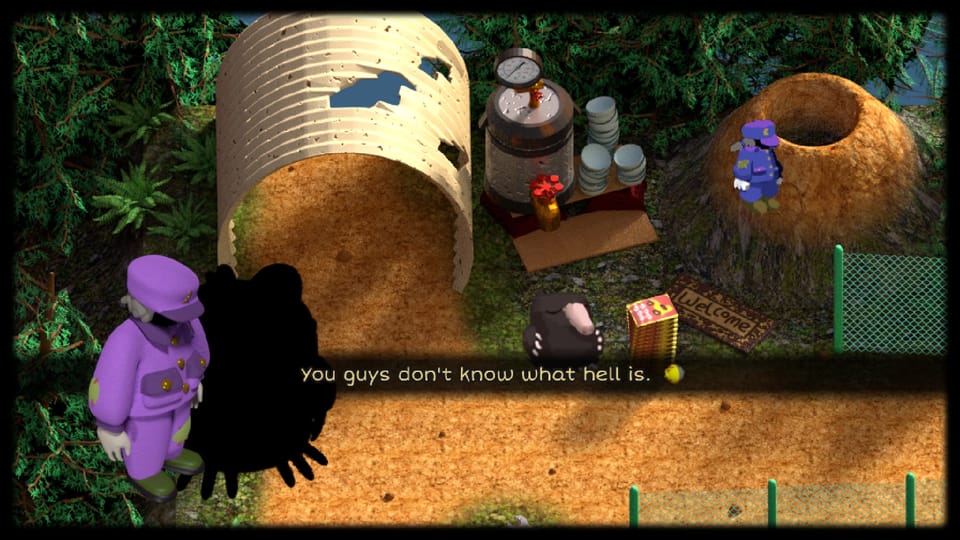
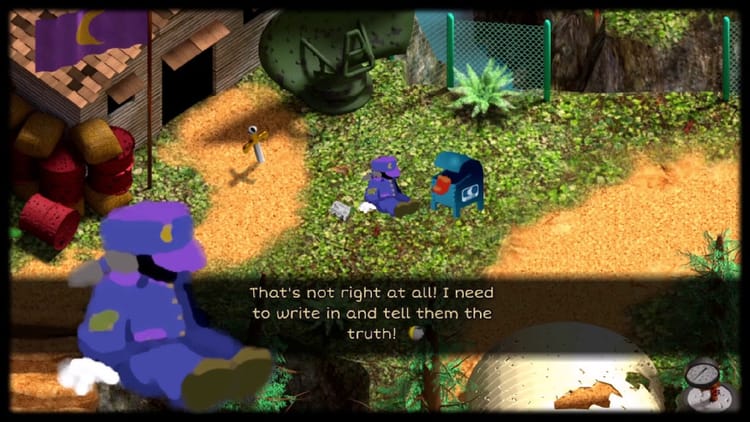
The perception of Home is dispersed across a whole community in 24 Killers and beyond, as Artemis captured in her piece. In fact, the further we venture into the digital age, home is not just untethered, it's become something of a purgatory. The pandemic exacerbates this truth, as it exacerbates the amalgamation of private spaces with public and commercial ones. It's a very deliberate choice to personify Home in 24 Killers as a dynamic entity trapped in a corpse. An early line of dialogue from Moon, your mission giver and the person that traps Home's soul in that corpse, is striking: "Home is an Echo. Echoes are powerful entities that come from a place where there's no peace of dark, or comfort of light." All Echoes eventually become cursed in this multiverse, "where universes float like foam on a vast sea." This last quote, for clarification, is stated at the start of the game when the narrator is setting the stage for the player. It evokes the strangeness of home and how the pandemic has accelerated the destabilization of the heterotopias we may call home. Houses haven't been just places to rest our head and find (brief) solace since modernity began, but illness, class inequity, climate change, reactionary politics, and displacement have weaponized literal houses and figurative homes.
In recent years, we've seen an uptick in the amount of art unpacking the atomization of truly private and communal spaces. Jenny Odell tackled some of this state of affairs in her book How to Do Nothing. She argues that we need to deliberately cultivate and protect our embattled attention span for the things most life-enriching to us. Our environment, like the idea of home, sustains the lives that make up our communities. As Artemis has asserted, home is other people.
Solarpunk critics like Andrewism and novelists like Becky Chambers offer a more grassroots perspective of the atomizing of the private home space and the attendant partitioning of the individual from their respective personal communities. Andrewism tackles this atomization and the loneliness epidemic from the standpoint of radical community building.They explore how the knowledge of African continent villages has been co-opted and watered down by the digital age. Chambers, in her Monk and Robot duology, captures a keen sense of how strange the human perspective of home and its location is. Both novels utilize the travel narrative to showcase several progressive communities in its post-technocratic collapse world.
Sibling Dex, the travelling tea monk protagonist, lives out of their sustainably-built wagon, which is also the site of their vocation and its supplies. When they first leave their monastery, Meadow Den, they realize a day after their departure that, in spite of spending a considerable amount of their adulthood living there, that place was no longer their home. Just the setting became estranged from them, so did the infrastructure Dex thought represented their whole experience and identity with their faith.
And as they journey throughout their world, serving tea and offering advice to various individuals, they realize home is not a fluid state for humans alone, it's often a construct that is "carved out and overlaid" in a world's ecosystem. The wilderness is in fact not an in-between space, as Sibling Dex learns from their friendship with Mosscap, the sentient robot who was "wild-built". To be wild-built is to be a construct salvaged from components of other robots left in the wild. Mosscap and its community live in the wilderness and study nature purely out of curiosity. This gives Mosscap the unique perspective of an inorganic being that lives in sync with the rhythms of organic beings. Many conversations Mosscap and Dex have center on how human infrastructures, both socially and architecturally, seem arbitrary and artificial. The natural world Mosscap inhabits simply exists without any pretense to being the default mode of living, while the human world is more interstitial and an interruption of sorts to the natural world. Even as human civilization has become less dense and more in tune with ecological rhythms, humans continue to view themselves as occupying the "empty" spaces of nature.
For both monk and robot, home and its ever-shifting nature highlights that assertion of Rebecca Solnit's: "[t]he places inside matter as much as the ones outside. It is as though in the way places stay with you and that you long for them they become deities—a lot of religions have local deities, presiding spirits, geniuses of the place." In other words, home can be a sacred space, one that is becoming harder to cordon off from the more urbane parts of society.
The sacredness of home, however, is not difficult to rediscover. This quality may be dispersed and suffused among the mundanities of life, both physical and temporal. But we keenly feel the absence of home as a third space and community as that third space continues to shift and shrink in location and size. Globally, we are also aware of mass displacement and weaponization of home as an ideal, which has been ongoing for decades before the pandemic. Examples include the Israeli genocide of the Paslestinian people, the destruction of people and land in the Congo, ICE deportations, Iran's recent uprising--which mirrors other uprisings against corrupt governments--devastation by environmental crises in the Philippines and the Caribbean, and more. As Indigenous scholar and activist Patty Krawec stated in the introductory section of her hybrid manifesto and flash fiction book Bad Indians Book Club: "Where we are from is a fraught question…[in a colonialist-imperialist context] where we are from determines where we are supposed to be and gives government — as well as those it deputizes formally and informally — the right to remove whoever it decides belongs someplace else." Krawec, citing many radical texts across many cultures, also locates home and belonging within interrelationships and not in arbitrary colonialist-imperialist boundaries of race and land. Your relationship with your community and land is not determined by blood or divine right, in other words.
One compelling exhibition I attended last summer, +1-home, uses a mixed media approach to communicating the otherness of home and its heterotopic quality. Collaborating artists Sonya Mwambu and Nada El-Omari used the motif of calling cards, often prevalent in immigrant families like theirs (and mine I should add) and put them in conversation with current communication technology like Zoom and WhatsApp to showcase the many ways we keep in contact with community and make memories of home over time and space. I had the opportunity to speak with them near the close of their installation at my local gallery and artist collective. There, it took on the form of a interactive digital museum of rooms containing various recordings and artifacts of the artist's daily lives during the early years of the pandemic and quarantine.
There's a game-like exploration function which puts the gallery visitor in a first person perspective so that they can traverse several themed rooms covering family conversations, food, textiles, and more. The gallery room was strewn with locally sourced props and the personal belongings of both artists, collected over the course of their different installations of this project. This installation created a sort of deconstructed living room that envelops the visitor, yet makes no illusions about the in-between nature of home as an archive. Speaking on behalf of both of artists' vision, Mwambu told me they wanted to make sure the installation could be physically visited. The original exhibition, via the AGO, was fully online, existing as a website where you could choose which rooms you wanted to view. The artist duo wanted to emphasize the multiplicity of home by having the physical person be immersed, not just in the digital mosaic of home, but in the textures of their surrounding environment.
The polluted island setting of 24 Killers is an effective microcosm for what the interrelationship of home and community could be like. The driver for this speculation is the game's absurdism. We can create homes in the middle of nowhere and begin again in the detritus of society. We can recreate spaces together. A reanimated corpse and their community of monsters or "mons" (as they're called in the game) can help each other thrive. Tater, one of those mons, suggests that the island might be the first "post-scarcity community" they've encountered. Home declares scathingly that scarcity only exists in human society. I can't say I wholly disagree, but I hope more game narratives continue to unpack themes of community and how strange yet vital they are. In spite of our current reckonings, both physically and temporal, authorities cannot define or fetter home.