
Home is a Multiverse - An Interview with Sonya Mwambu and Nada El-Omari about +1-home
Artists and filmmakers Sonya Mwambu and Nada El-Omari started collaborating back in 2015. Their latest and ongoing project is +1-home, a hybrid art installation and digital exhibition from 2021. The project uses the motif of the calling card to share not just the memories of their various homes throughout this ongoing pandemic, but to capture the mulifariousness of our sensorial perception of home. As our pieces for our 24 Killers issue attest to, the most arbitrary aspect of home is the physical space we inhabit with our companions and loved ones. Ironically, the most ephemeral aspects of a home, like the smell of a certain blend of spices associated with a family recipe or the sound of a zoom call with relatives abroad, are the most substantial qualifiers.
I had the opportunity to converse with these artist-filmmakers via a video call after attending an iteration of the +1-home installation at Struts Gallery in New Brunswick. I actually visited the installation twice. Once on my own and subsequently with my mother. My mother's generation has a different era’s notion of what a gallery visitor is allowed to do. She also has a different set of associations with the themes of home and displacement than I do. I was curious to see how she would react and interact with +1-home. This Struts installation is perhaps the most intimate iteration of the project, Mwambu explained to me that at the start it was completely digital in nature. This was when +1-home was exhibited at the Art Gallery of Ontario.
“[The] first iteration of this [at the AGO], it was fully online. And it was just…a website that was created that had all of those different [rooms]”, Mwambu explained to me when I asked about the differences between the current installation and previous ones. They and El-Omari then continued development of the project with the support of InterAccess’ inaugural artist-in-residence program IA 360º. This connected them the technical support of Terry Anastasiadis and Kyle Duffield. The iteration that was installed at InterAccess was more akin to the one I visited at Struts, in that there was more of a physical externalization of the digital AGO exhibit. The visitors to the InterAccess +1-home were in one large room where they would operate a two-player interactive experience utilizing InterAccess’ 360 projection system. “And then when we went to Struts, it was the second physical iteration of it where it’s a little less complicated, so it’s just the one player game.” Mwambu continued, delineating the timeline of the project. This timeline was important to me, as the experience I had at Struts, by myself and then with another participant, felt thoroughly considered.
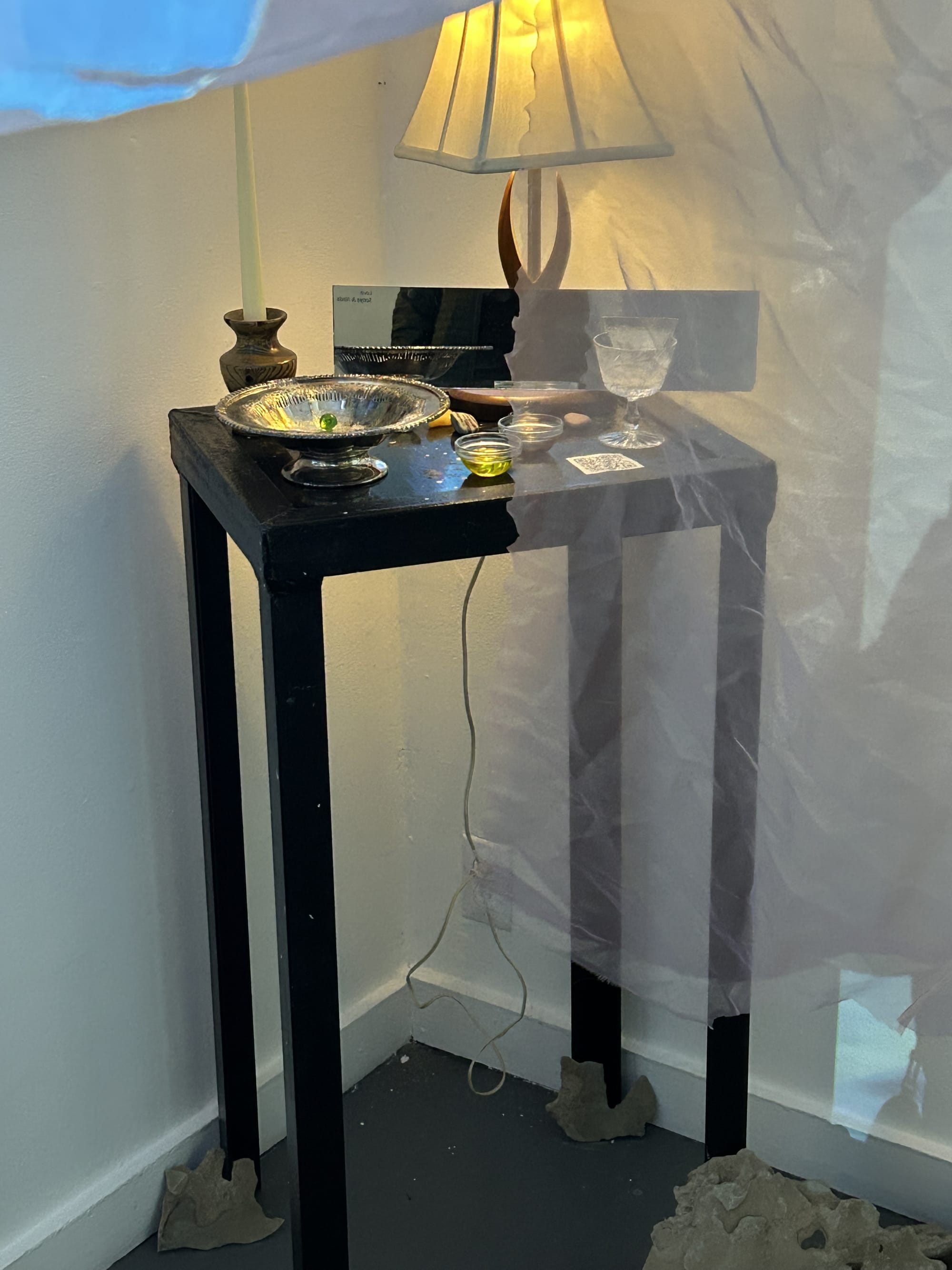
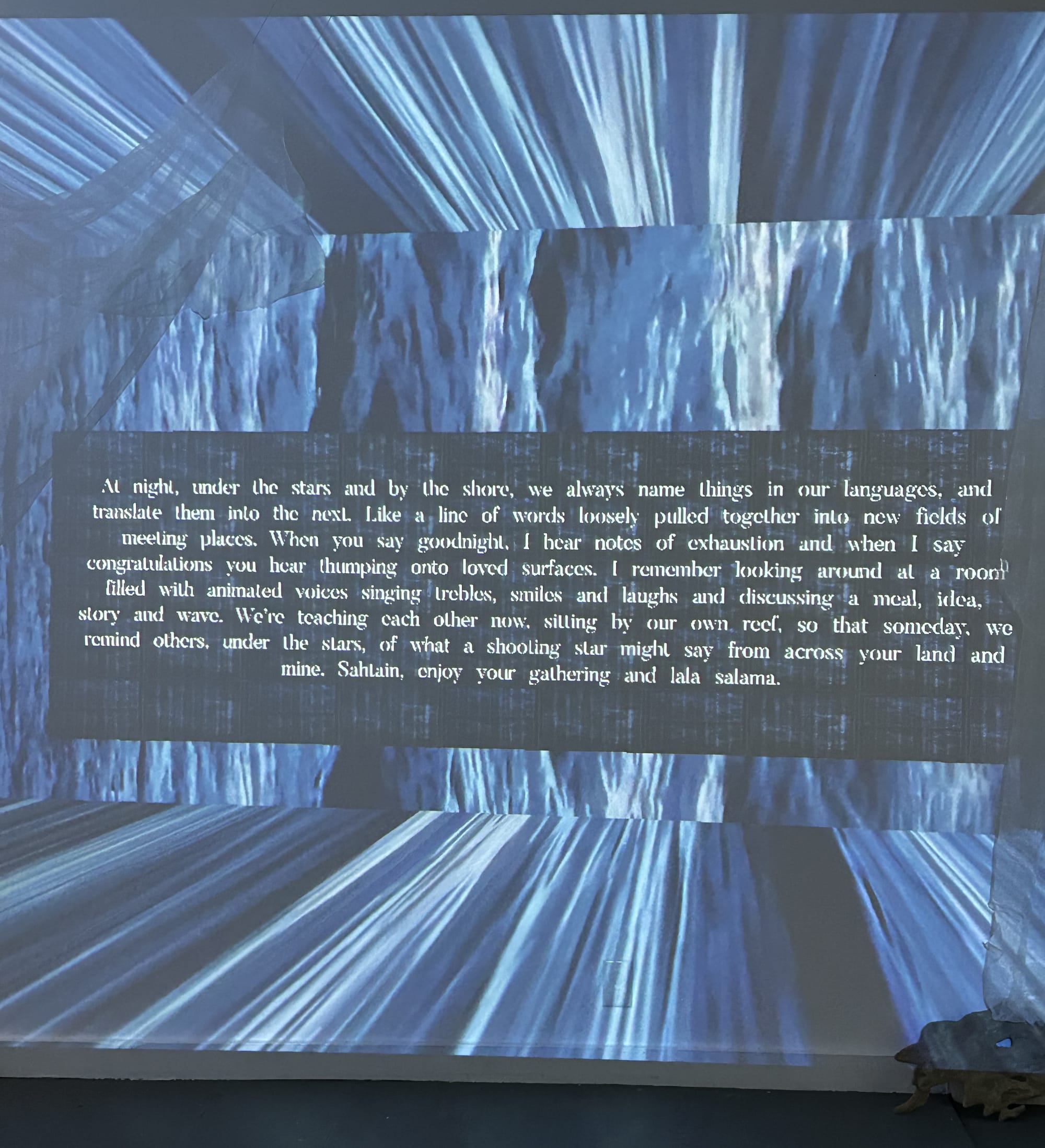
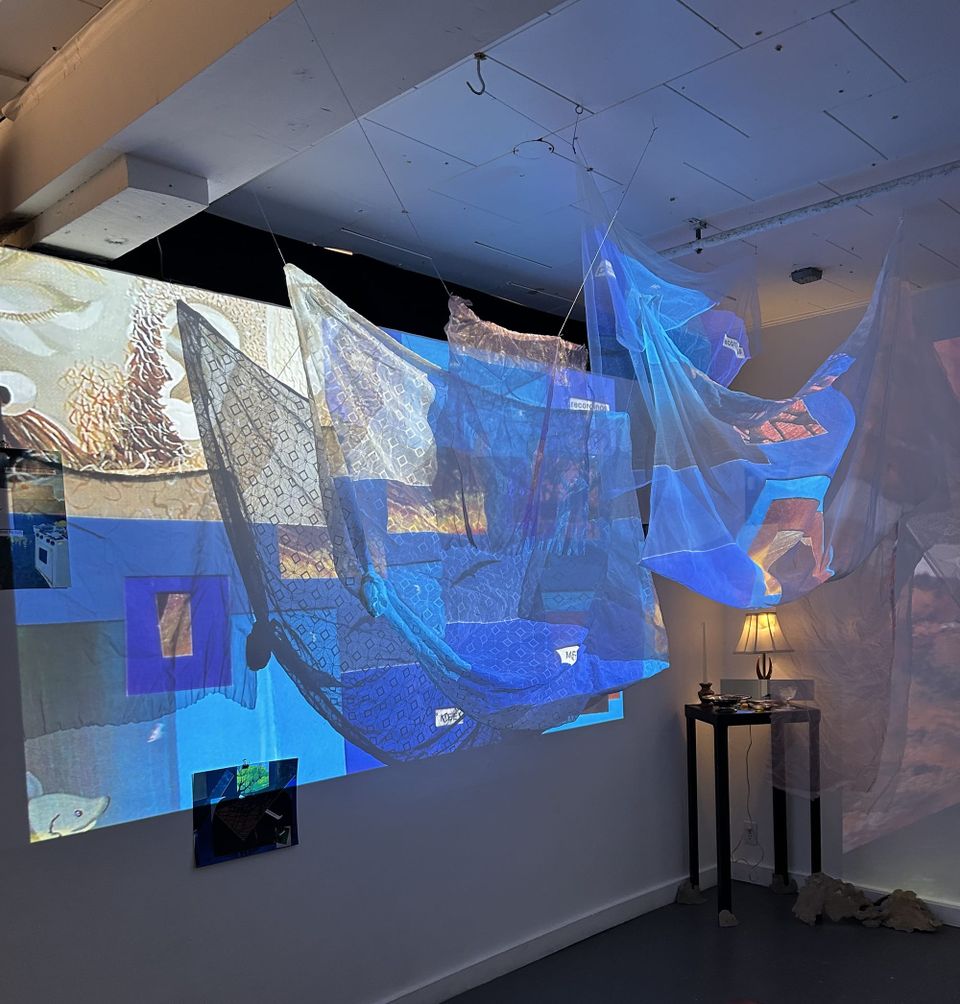
The room at Struts, entitled “The Primrose Room”, was equal parts stage design and digital simulation. The room was draped in both gauzy transparent fabrics on the left side of the ceiling, which would reflect some of the projection of the digital exhibit on the far wall. I told them those fabrics and the way the layers of drapes did this made the digital projection at times look like it was fragmented into multiple overlapping computer browsers. The fabrics of course functioned first and foremost as reminders of the physical space of the room. One that resembled an amalgam of memories from both Mwambu and El-Omari’s different homes, in Canada and abroad. There was also a folding screen featuring luxurious shawls with intricate prints. On the floor was a plush rug that reminded me of 80s and 90s decor. “[At Struts] we explored a little bit more with the physical installation of it.” Mwambu continued. Struts gave the artist duo rooms to stay in above the gallery during the four or five days of installing the exhibit. They wanted to emphasize the tactile and concrete details of the installation this time around. Because despite the digital aspect of the exhibition being a key element of the temporality of home, they understood that these physical and digital spaces are nested together in the homes they’ve lived in. So, although the installation at Struts alludes to a singular space at the outset, you’re really interacting with any or all the rooms that were previously organized in the AGO exhibit by specific calling card links on the website. The Struts digital simulation appeared as a surreal courtyard, with each of the rooms there for you to freely explore. In the centre of this courtyard there is a golden bowl accompanied by text which clarifies that bowls like these existed in many homes that would collect various items like keys, calling cards, mementos from daily treks outside. This bowl is echoed in the physical installation and stood nearby a rotary phone and guestbook.
The bowl is a somewhat fixed part of the installation, El-Omari told me, meant to characterize a commonality that many visitors of various generations might resonate with. For each iteration of the physical part of the project, the artists would source a different bowl from the area that +1-home would be installed. “[Each] bowl is different in whatever physical space, but it relates to the one that’s in the digital world. And so it kind of just brings all, also the different spaces that we put up this in and all the people who come to it [together].” The bowls are something that, as the project hopefully continues on into the future, the artists will present as a unifying symbol. For me this represents the eclecticism and transience of all our homes. I should mention that the golden bowl in the digital courtyard is itself also contained in a box. You have to clip through the wall of this box to see the golden bowl and its attendant writeup. For me, this gets at how the meaningful yet mundane objects we interact with on a daily basis become invisible. Even if you're a minimalist by choice or necessity, objects like these become an extension of us. They are a signifier for personal rituals and how we habitually relate to our sanctuaries and those we share them with.
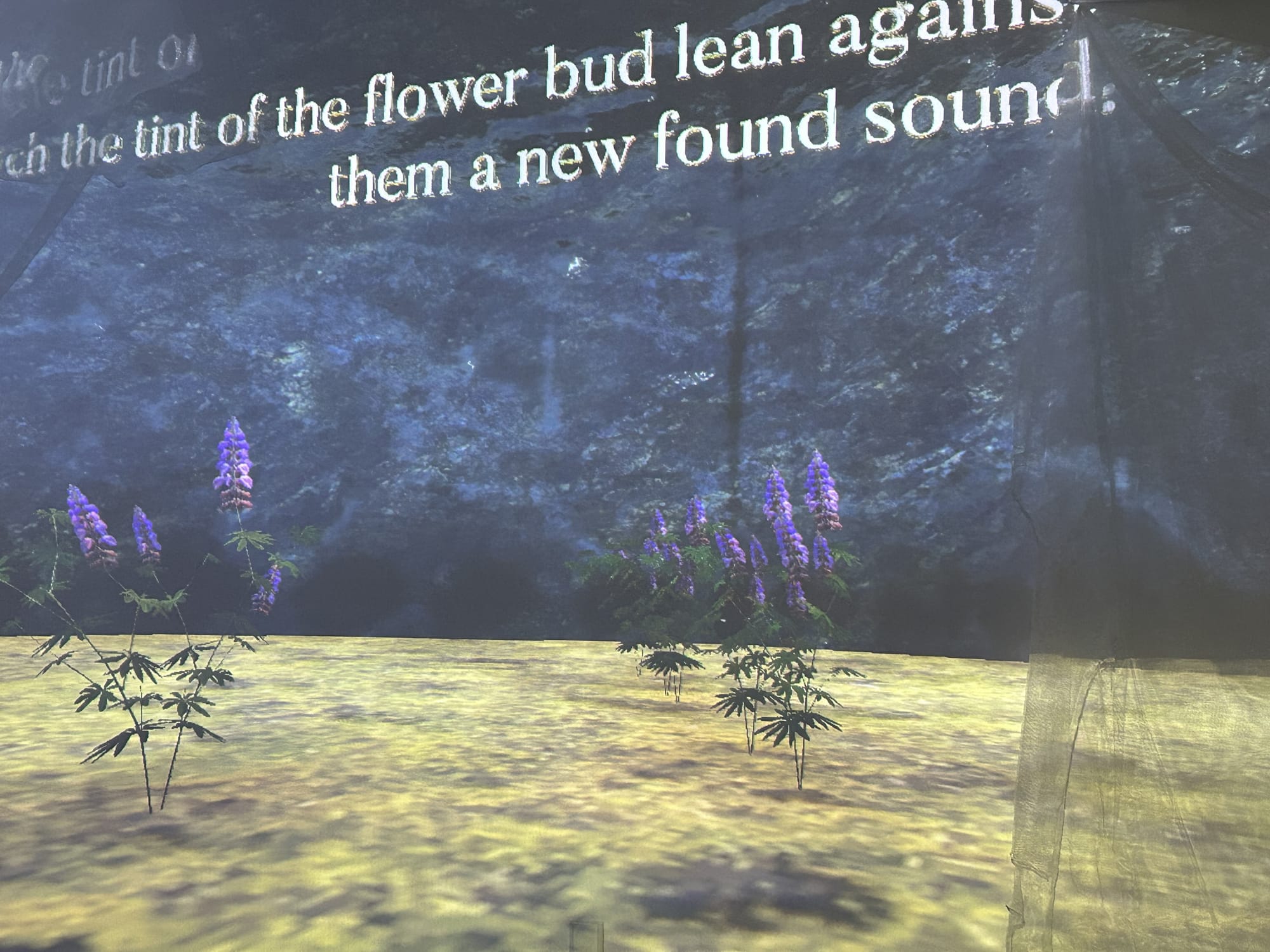
The digital rooms of the Struts exhibit, which uses Unreal Engine for construction of its environment and traversal controls, most of the surfaces are scans of various home artifacts and sound recordings as well. These rooms, based off the calling card motif of the first iteration of +1-home, are even referred to by the artists as their central artifact. Regarding the curation of these artifacts and their textures, El-Omari gave a detailed explanation of the duo’s approach:
“[Most] of them are really meant to relate to like the texture of each room, right? So [the] stained glass one—[the] sound there is made [from] stained glass cuttings. The fabric room [displays related] conversations from the lands where we associate some of these fabrics [from.]" El-Omari also detailed how one room showcases photos of various landscapes she and Mwambu associate with their homes. "[They're] all recordings that we gather. [So] all the spaces that we relate to [are where] these memories live, right? Because sound is such an important part of memory and of physical memory. [But] it's all process-based. So the way we choose [and create] is all process-based, whatever sort of rings right in that moment is the way we tend to lean, I would say.”
Mwambu and El-Omari added that another part of their process for staying true to the hybrid and kaleidoscopic nature of home-related memories was locally sourcing some of the materials for the physical installation. Most of the fabric, the retro lamp, and all the rock keepsakes were from places nearby the gallery or were part of donations left to the gallery. Not all materials were locally sourced for the physical part of the installation—Mwambu sourced the hanging mosquito net from the right side of the room’s ceiling from a recent trip they made to Uganda. In the previous Toronto iteration the duo incorporated a lot of glass that came from Mwambu’s father, who is a big part of both her and El-Omari’s lives.
At times reflecting on my experience of this exhibit over the past year, it’s difficult not to fall into recursive thought patterns about it: Home and how it’s characterized by our families, blood-related, chosen, or both, is a recursive subject. It’s generational. And as such the happenings in a home are recursive as well (change is the only constant and all that). I feel fortunate then, that I visited +1-home both as an individual of a specific generation, an older millennial that is used to the transmedia approach of such installations, and once more with my mother who’s a gen Xer used to holding themselves at a respectful distance for most gallery visits.
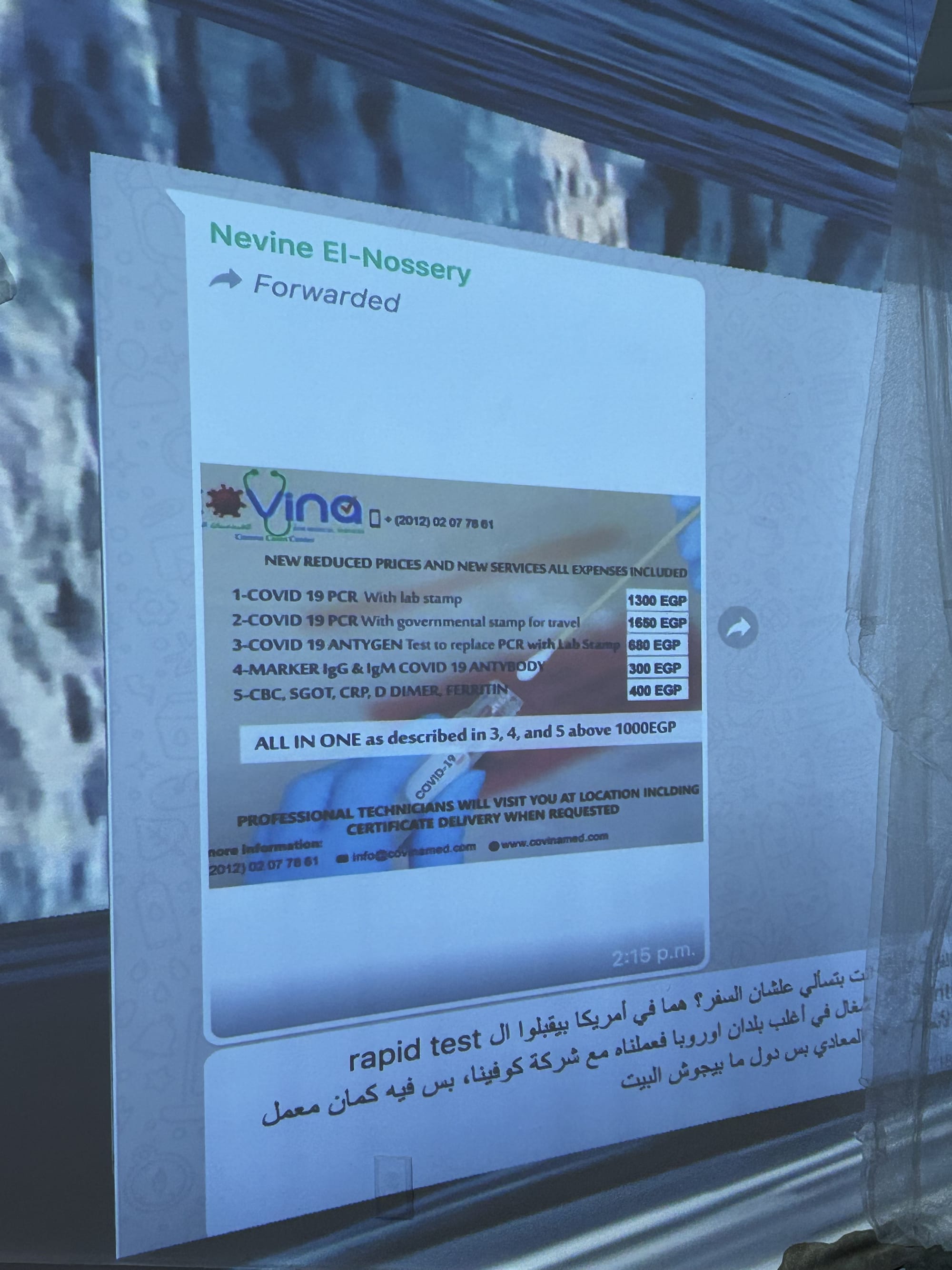
The installation, when two people or more are present, easily generates intergenerational discussions of what such a space means to them. What it makes them remember, for better or worse. My mother saw one particular text in the digital exhibit that touched upon displacement and emigration and she reminded me that her late father was displaced during the second war from his hometown. He emigrated to Canada, but throughout his life would travel back to visit his surviving relatives. He’d feel at a remove from the spaces he was once familiar with, not just from acculturation in Canada, but from seeing the way things had been rebuilt after the war. The previous spaces literally no longer existed in their entirety and so the hometown he associated himself with existed only in his memories. Our emotional connections to home are neither neutral nor wholly sentimental.
El-Omari commented that the idea of the calling card as an organizing motif was one that, while era-specific, was surprisingly flexible for intergenerational communities to relate to. Each generation has their version of the calling card, whether it’s the initial prepaid plastic, credit-card sized calling cards from the 70s together with landlines, MagicJack phoning, to eventually group texting on WhatsApp and Messenger, and video calls on Zoom and Google Meet. “it’s a way to gather everyone into an exchange, right…that’s the beauty of calling cards across [families]…we all live in [this] world where we’re all kind of apart in many ways.”
Something important to note about +1-home is that it’s not an art game couched within a gallery installation. Despite my obvious affinity for the digital interactive portion of the project and its creation via a game engine, the game-like aspects of the simulated rooms and their first POV, which put me in mind of famously introspective walking simulators like Gone Home, Dear Esther, and What Remains of Edith Finch, it’s a facilitator. One that allows visitors to, with relative ease, observe without trying to construct an overarching linear narrative or reach an end state.
Speaking for the both of them, Mwambu asserted when I asked about the game-like exploration: “We are not gamers. [My] friends like a lot of like video games, talk about it all the time.” Mwambu in particular enjoys games that are like The Sims, simulators that emphasize the social aspect of gaming and aren’t necessarily full of button combos and numerous controls to memorize. But they also aren’t a stranger to games development either. Recently, at the time of the interview, they had done a play test for some indie developers who are friends of theirs, working on a project in Iceland. “[We’re] calling it [the digital part of +1-home] a game because that’s just how an interactive experience [is referred to].” In other words, it’s more about the immersive aspect of the digital exhibition than it is about “completing” an experience of said digital exhibition. Though in the InterAccess iteration, interestingly enough, the digital POV had to be more fixed, since the two people experiencing it would be in each other’s field of view. The camera for the Struts iteration isn’t as tethered, so navigating it is more dream-like and allows viewers to look at the exhibit from more angles, including from above.
Another reason for ensuring the digital exhibition remained simple and focused on exploration was for accessibility’s sake. Similar to concerns that Nilson Carroll had with designing SEQUENCEBREAK//, the artist duo wanted to avoid visitors feeling intimidated to interact with the installation because of the presence of a game controller. “[You] would see like people who are gamers come in and they'll be like, ‘oh.’-[Mwambu gestures like they're confidently holding a controller] And then you'll have, you know, other people come in here like, ‘listen, I've never played a video game in my life. But I could move around.’” The strength of +1-home’s hybridity comes into play here, the transmedia experience allowing for multiple ways to interact with the installation. As experimental filmmakers, Mwambu and El-Omari are used to taking certain technologies and multimedia and repurposing them so that they can tell their own stories and share their own experiences. Because of their artist residency and its comprehensive mentorship, they were able to produce +1-home. Mwambu’s friends in game development were able to field questions as well, so the project owes its existence to an extended creative community.
When I asked what the future might look like for this project, both Mwambu and El-Omari expressed that they hope for it to be something that they could work on for years to come. They would like for the installation to continue expanding and allow for a larger sequence of time and memories to be included, not to mention perhaps integrating more multimedia elements as well. A lot of the conversations, both in WhatsApp texts and Zoom calls, are now over five years old, since the project started during the beginning of the pandemic. Mwambu’s little cousins featured in one of those Zoom calls have grown up in that period of time. “So when we made this…we lived in the same apartment. The second one we has just moved [apart] and then now we’ve been living in different cities for a few years.” El-Omari told me. When I spoke with them, Sonya was in Toronto and Nada was in Palestine. With everything going on these days, it struck me deeply that the kinship these two have will continue to be documented, even if between the lines of this +1-home project. Kinship is what keeps our homes alive and creates endless memories that leave both a physical and digital trace.